
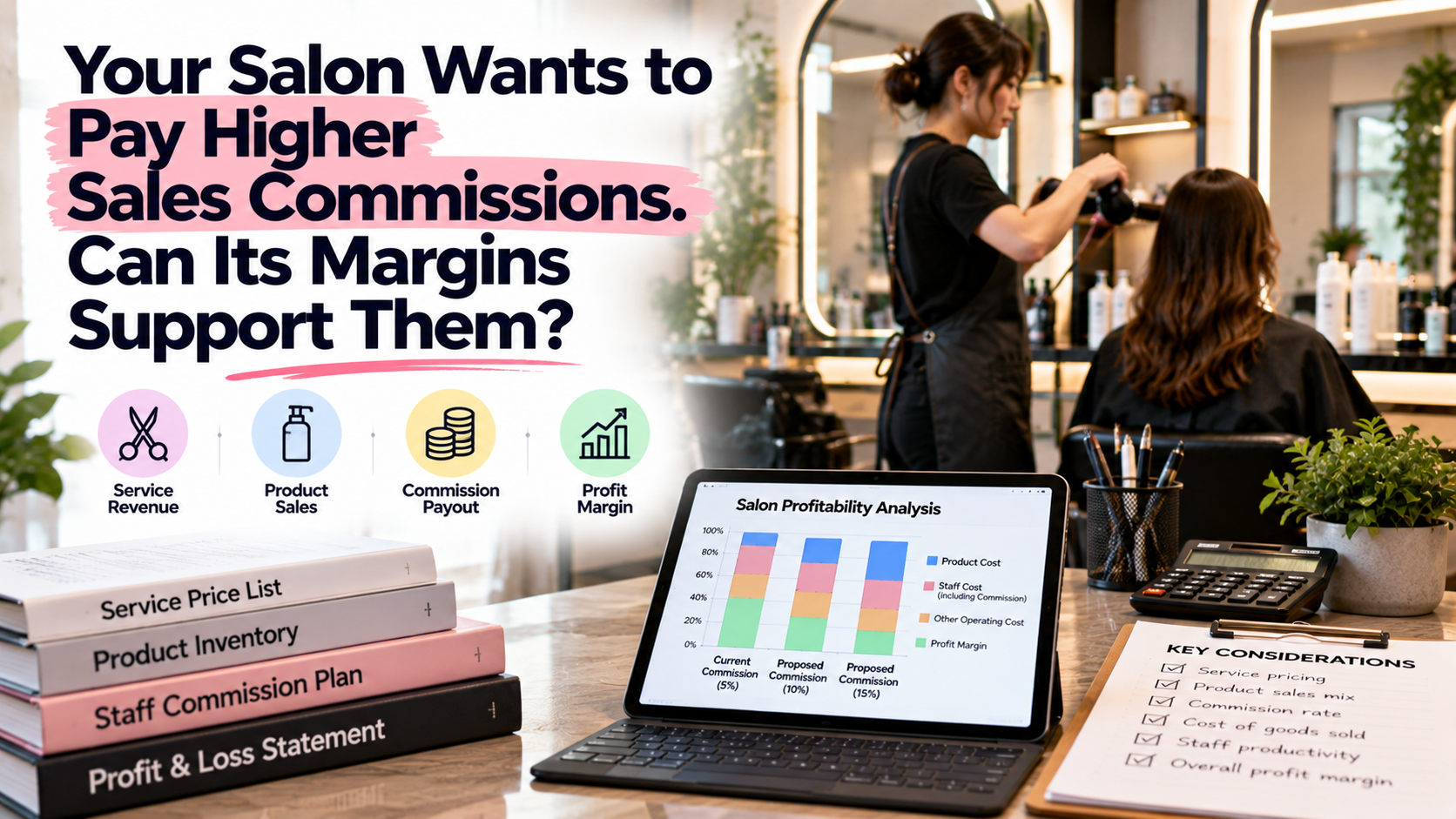
Your stylists want a better commission rate. Competitors are recruiting, appointment slots are filling up, and you want to reward the employees who keep customers returning. Raising the percentage seems like a straightforward way to recognise performance while linking additional pay to sales.
However, an increase in commission can affect the salon’s finances more than the headline percentage suggests. Discounts may already be reducing what customers pay, some treatments use expensive products, and packages sold today create appointments that must be delivered later. Higher sales do not automatically leave enough money to cover a higher payout.
Before introducing a new rate, understand what the commission is calculated on, which services can support it and how much additional business would be needed to preserve your current earnings. That review can help you offer a scheme that is attractive to employees and affordable for the salon.
Define What Counts as a Commissionable Sale
Start with the calculation itself. “Ten per cent of sales” can mean different things depending on whether the figure includes discounts, refunds, retail products, package collections or services redeemed from an earlier purchase.
Document the base clearly. If a treatment has a list price of S$200 but the customer pays S$160 after a promotion, establish which amount generates the commission. Where GST applies, make clear how it is treated in the calculation rather than leaving the payroll team to make assumptions.
Consider shared appointments as well. One employee might recommend the treatment, another perform it and a third sell the customer a home-care product. The scheme needs an understandable method for allocating credit without accidentally counting the same sale several times.
A clear calculation makes the cost predictable and helps employees understand their earnings. It also provides a reliable starting point for comparing the current arrangement with the proposed one.
Understand the Contribution From Different Services
Two services with the same selling price may leave very different amounts available to cover wages, rent and profit. One may require a small quantity of product and 30 minutes of work, while another uses costly materials and occupies a stylist for two hours.
Build a practical view of the main service categories. Use the actual selling price after discounts and identify consumables, payment fees and other costs that vary with the appointment. Then deduct the commission and any associated variable employment costs included in your analysis.
Be consistent about basic wages. If they are treated as a monthly cost in the salon forecast, avoid deducting the same amount again without explanation when combining service-level results. You can also prepare a fully allocated profitability view, but keep it distinct from the contribution calculation.
Start with the services that account for most sales rather than attempting to cost every possible treatment immediately. The aim is to identify where a higher commission is readily supported and where the remaining margin is already thin.
See What a Rate Increase Does to One Appointment
Consider a simplified hypothetical treatment with a net selling price of S$150. Products and other appointment-specific costs total S$35. Under a 10% commission rate, the employee earns S$15, leaving S$100 towards basic wages, occupancy costs, other overheads and profit.
At a 15% rate, the commission becomes S$22.50. The remaining contribution falls to S$92.50. That is a reduction of S$7.50 per appointment, before any additional employer payroll costs associated with the increase.
If the salon delivers 400 identical appointments in a month, the contribution falls from S$40,000 to S$37,000. To generate at least the previous S$40,000 at S$92.50 per appointment, it would need 433 appointments, assuming the same prices and costs.
These figures exclude employer CPF, tax effects and capacity changes. They are not suggested commission rates. They illustrate why a five-percentage-point increase needs to be translated into dollars and the additional activity required to fund it.
The next question is whether those extra appointments are achievable. If the diary is already full, a plan dependent on more bookings may require longer hours, more employees or a change in service mix.
Check How Promotions Affect the Payout
Discounts and commissions should be reviewed together. A promotion can reduce the salon’s receipts while leaving product usage and appointment time largely unchanged. If commission is still calculated on the original list price, the effective payout becomes a larger percentage of the money collected.
Suppose a service normally sells for S$200 and attracts a S$20 commission. A promotion reduces the customer’s payment to S$150, but the commission remains S$20. The commission now represents approximately 13.3% of the selling price rather than 10%.
That does not necessarily make the promotion unsuitable. It might fill otherwise empty slots or attract customers who return. However, those benefits should be assessed alongside the lower contribution and any additional marketing expense.
Review who can approve discounts and how promotional services are identified in the sales system. Staff should be able to explain the offer to customers and understand the related commission without relying on informal exceptions decided after payroll is prepared.
Treat Package Sales and Redemptions as Connected Events
Packages create a particular challenge because cash collection and service delivery occur at different times. An employee may sell a package today, while several colleagues provide the treatments over the following months.
For internal planning, examine the economics of the whole package. Consider a hypothetical five-session package sold for S$600. Spreading that price equally gives S$120 per session for a simple management comparison, although the appropriate accounting allocation may differ where the included services have different values.
Assume the salon pays an 8% selling commission on the package, or S$48. It also pays S$10 to the employee delivering each session, adding S$50 across five sessions. Total commission is S$98 before related employer costs, equivalent to about 16.3% of the package price.
Neither payment is automatically unreasonable. The issue is whether the package price supports both, together with products, appointment time and overheads. Looking only at the initial 8% would understate the total incentive cost.
Keep package collections, remaining sessions and delivery commissions linked in your records. That helps management see the work still owed to customers and the costs that will arise when they redeem it.
Include the Full Employer Cost
The salon’s cost may exceed the commission amount shown on an employee’s payslip. In Singapore, commissions generally attract CPF contributions for eligible employees, subject to the applicable rules and wage ceilings. The additional employer contribution should be reflected where relevant.
Use the employee’s actual circumstances and the applicable wage treatment when estimating that amount. A single assumed percentage across every employee can produce an inaccurate budget. The employee’s CPF share withheld from gross pay should not be added again as though it were a separate employer expense.
Include other incremental costs where the proposed scheme is expected to change working arrangements. More appointments might require additional support hours, laundry, cleaning or administration. Those costs should appear in the forecast if they are necessary to deliver the expected growth.
A payroll review can help translate the proposed rate into a realistic total cost before management announces it. Employees can then receive a clear explanation of the scheme while the business understands its financial commitment.
Make Sure Capacity Supports the Sales Target
A higher commission may encourage more selling, but it cannot create unlimited appointment capacity. The salon has a finite number of chairs, rooms, staff hours and desirable booking slots.
Look at contribution per occupied hour alongside contribution per appointment. A long treatment may generate a larger bill while leaving less contribution per hour than a shorter service. The comparison is particularly useful during periods when demand exceeds available slots.
Avoid treating this as a reason to rush appointments or discourage appropriate treatments. Service quality and customer trust affect repeat business. The purpose is to understand the financial consequences of the booking mix and price services appropriately.
Distinguish peak periods from quieter ones. An additional appointment in an otherwise empty slot has different implications from one that displaces another booking. Your forecast should explain where the expected additional sales will fit.
Consider What Behaviour the Scheme Encourages
A scheme based entirely on gross sales may encourage employees to favour high-ticket packages or heavily promoted products, even when those sales leave limited contribution. It may also give little recognition to employees who perform the services after someone else earns the selling commission.
Identify the behaviour you want to reward. That could include profitable service delivery, appropriate retail recommendations, customer retention or teamwork. Use measures that staff can understand and influence, rather than a complicated formula they cannot independently check.
Be careful with thresholds. If reaching a target triggers a higher rate on every sale for the month, a small increase in sales can produce a much larger jump in commission. Model results immediately below and above the target so that the effect is visible.
Different rates for different categories may be useful where economics differ substantially, but complexity has a cost. A scheme with too many exceptions becomes difficult to administer and more likely to generate disputes.
Plan for Refunds, Corrections and Shared Work
The scheme should explain how cancellations, refunds and complimentary corrective work are handled. Otherwise, the salon may discover that its records and employee expectations differ only after a customer complaint occurs.
Separate the commercial cost analysis from decisions about employee pay. A refunded service may reduce the salon’s realised margin, but that does not automatically justify deducting money from an employee’s wages. Any adjustment needs to comply with the agreed terms and applicable employment requirements.
Keep enough information to understand the underlying event. Was the refund caused by an unsuitable recommendation, a service issue or a customer changing plans? Did a second employee provide corrective work that also requires recognition?
These details help management assess the scheme without treating every exception as equivalent. They can also reveal whether training, consultation procedures or product selection needs attention.
Test the Proposal Against Actual Trading Records
Before adopting the higher rate, recalculate several recent months as though the proposed scheme had applied. Include both busy and quieter periods, along with actual discounts, package activity and refunds.
Compare total commission, related employer costs and the remaining salon contribution under each arrangement. Identify which employees and services are most affected. This gives management a clearer view than applying the percentage increase only to total reported sales.
Then prepare a forward-looking scenario that includes the improvement you expect from the scheme. Keep that separate from the historical recalculation, since past sales cannot demonstrate that a new incentive will generate future growth.
Also test an outcome in which sales do not improve. Management should understand whether the higher payout remains affordable and how it affects the cash available for other commitments. If a trial is proposed, define its duration, terms and review process clearly before it begins.
Use Better Reporting to Support a Sustainable Scheme
A useful monthly report should connect net sales, service categories, package activity, commissions and associated employment costs. It should also show appointment hours and significant refunds or corrective work where those explain the financial result.
Review the figures with the people responsible for sales, operations and payroll. A margin problem may arise from discounting or product usage rather than the commission rate alone. Clear records help management identify the actual cause instead of repeatedly changing incentives in response to a weak month.
Gekonnt provides accounting services, including financial analysis and advisory support. For a salon reviewing its commission structure, organised service and payroll records can provide a stronger basis for assessing affordability and monitoring the outcome.
Higher commissions can be a reasonable investment in employee retention and performance. Before committing, establish the total payout across sales and service delivery, the contribution left after variable costs and the additional activity the salon can realistically support. Those answers help management design a scheme it can honour consistently.