
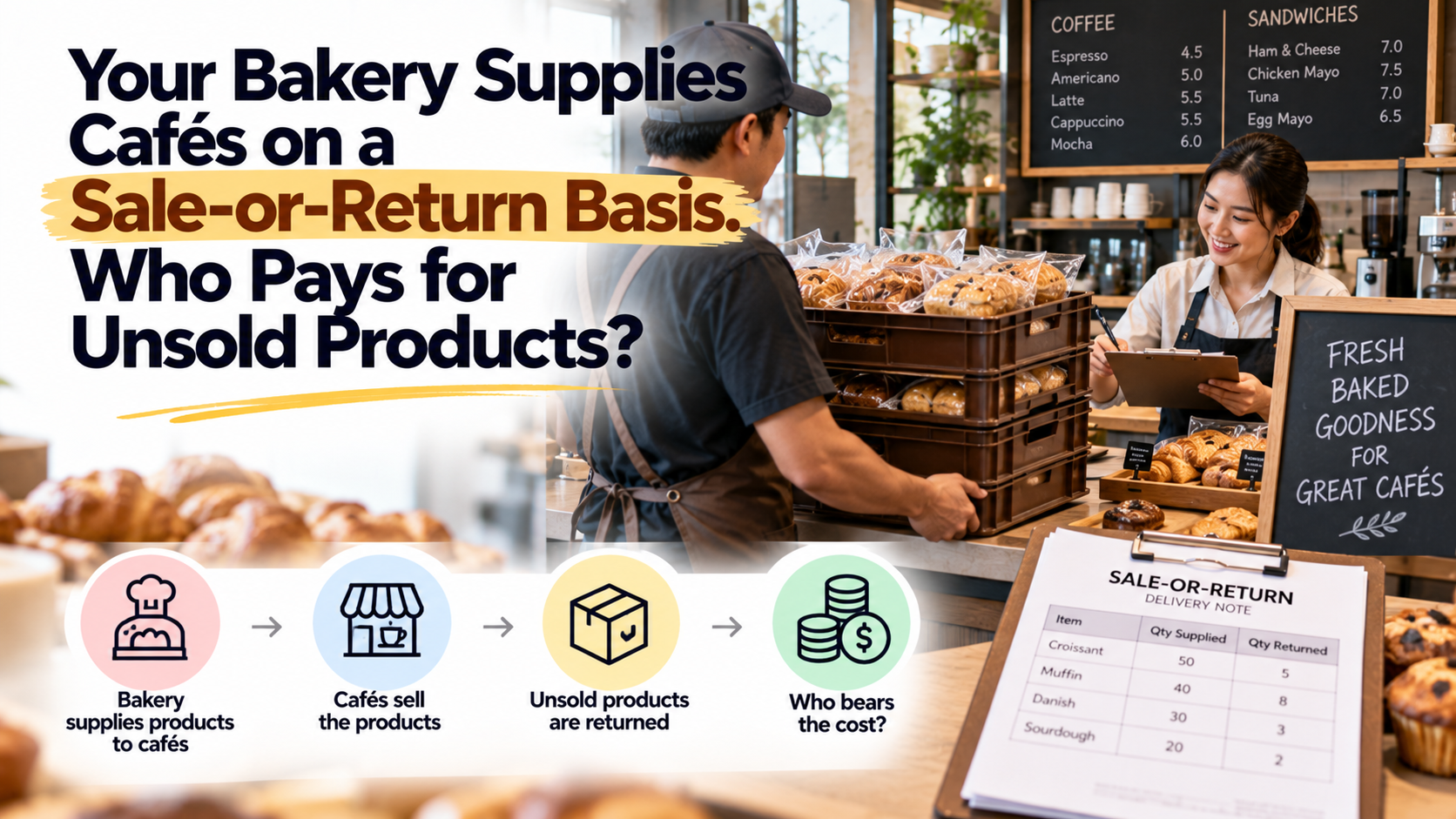
A café wants to stock your pastries, but it is unsure how many customers will buy them. To make the arrangement easier, you agree that it will pay for the products sold and return the rest. The café can offer a fuller display, and your bakery gains access to customers without opening another outlet.
The arrangement can create useful business. However, a delivery of 100 pastries does not necessarily produce payment for 100 pastries. Your bakery has already used ingredients, packaging, production time and transport before discovering how much of the batch will earn anything.
Under an arrangement that gives the café full credit for eligible unsold products, the bakery generally absorbs their production cost unless another recovery is available. The precise sharing of costs depends on the agreed terms. Before expanding the relationship, understand what you are being paid for, what happens to the leftovers and how much each delivery actually contributes.
Start by Defining What “Sale or Return” Means
The phrase can conceal different expectations. Your bakery may understand that only a limited quantity can be returned, while the café expects full credit for everything left at closing. One party may expect physical returns, while the other assumes a photograph and a quantity report are sufficient.
Put the commercial arrangement in writing. Establish which products qualify, the reporting deadline, the credit amount and any limits. Also distinguish unsold products from products rejected because they arrived damaged or failed an agreed specification.
Clarify who pays for collection, disposal and any additional handling. A credit for the pastry’s selling price does not explain who bears the cost of bringing it back. These details can determine whether a small café account is worthwhile.
Make sure the people placing orders, receiving deliveries and preparing invoices understand the same terms. A clear agreement is more useful when daily records and staff practices actually follow it.
Calculate Earnings From What the Café Keeps or Sells
Delivery volume is an operational measure. It shows what your bakery produced and transported, but it does not necessarily show what the café will ultimately pay.
For each delivery, connect the quantity supplied with the quantity eligible for credit and the final amount chargeable. Use the agreed wholesale price, rather than the café’s retail selling price, when assessing what your bakery earns.
Track the sell-through rate, meaning the proportion of delivered products sold to the café’s customers within the agreed period. A delivery of 100 items with 20 eligible unsold returns has an 80% sell-through rate. That percentage is useful only when the underlying records are reliable and comparable.
Assess results by café, product and trading day. An overall average can hide a profitable weekday arrangement alongside a consistently weak weekend order, or a popular pastry alongside another product that repeatedly comes back.
A Full Delivery Can Leave Very Little Contribution
Consider a hypothetical delivery of 100 pastries at an agreed wholesale price of S$3 each. Assume the café pays only for units sold, eligible unsold products receive full credit, and returned pastries have no recoverable value.
The bakery’s variable production cost is S$1.40 per pastry, including ingredients, packaging and genuinely volume-related production spending. Making all 100 therefore costs S$140. Delivery and handling for this order add S$25.
If the café sells 80 pastries, the bakery earns S$240. After S$140 of production costs and S$25 of delivery and handling, S$75 remains towards fixed costs and profit.
If only 60 pastries sell, the amount earned falls to S$180. Production and delivery costs remain S$165, leaving just S$15. At 50 sold, the delivery produces a S$15 shortfall before fixed costs.
These figures exclude tax and any additional return or disposal charges. They illustrate why a busy production schedule can coexist with weak earnings. The cost of the whole batch must be considered, including the products that generate no payment.
Find the Sales Level That Makes the Delivery Worthwhile
In the example, the bakery needs payment for 55 pastries at S$3 each to recover the S$165 of specified production and delivery costs. That is a 55% sell-through rate, but it does not cover the bakery’s rent, fixed payroll or other overheads.
If management wants the delivery to leave at least S$60 towards those costs and profit, it needs receipts of S$225. At the same price, that requires 75 pastries to sell.
The acceptable level therefore depends on what the bakery needs the account to contribute. A delivery that merely covers its immediate costs may be tolerable during a tightly controlled trial, but it provides little support for running the business over time.
Use the calculation as a decision aid, not a permanent rule. Ingredient prices, delivery arrangements and order quantities can change. Revisit the assumptions when the account’s pattern changes rather than relying indefinitely on the first estimate.
Avoid Producing More Simply to Fill the Display
A café may prefer a generous display because variety and abundance help its presentation. If it can return every unsold product without cost, its preferred order quantity may be higher than the bakery can profitably support.
Use actual sales records to discuss quantities. If a café regularly receives 100 pastries and sells about 60, repeatedly delivering the same amount needs a commercial explanation. A full display may have value, but someone is funding the unsold portion.
Test smaller quantities where practical. Compare the amount earned, production spending and any missed sales over several comparable days. Reducing waste is useful, but cutting supply too far can also limit profitable demand.
Agree how exceptional events will be handled. School holidays, nearby office closures and local events may affect demand. A café that shares this information before the order deadline gives the bakery a better chance of producing an appropriate quantity.
Review the Product Mix Before Changing Every Price
Returns may be concentrated in a few products. A café could sell most of its plain croissants while returning a large share of a more expensive filled pastry. Treating the entire account as one average can hide that difference.
Compare each product’s wholesale price, production cost and actual sell-through. Also consider production complexity. A small quantity of a specialist item may require a separate preparation process that is not captured by ingredients alone.
Discuss whether the range should change by day or location. One café’s customers may favour breakfast items, while another sells more afternoon snacks. Standardising every delivery for convenience can create avoidable waste.
A targeted change may improve the relationship more effectively than a general price increase. Removing one consistently weak item, changing its quantity or testing it on selected days can preserve the stronger parts of the account.
Include Delivery and Return Handling Properly
A café may appear profitable when you compare product receipts with ingredients, yet contribute little after transport. Small orders, narrow delivery windows and separate collection trips can make an account expensive to serve.
Record enough information to understand the route. Consider driver time, vehicle costs, parking and additional handling where relevant. Distinguish an extra stop on an existing route from a dedicated journey that would not otherwise take place.
For immediate decisions, identify what costs would change if the delivery changed. For longer-term planning, also assess whether the route as a whole supports its staffing and vehicle commitments. Both views are useful, but they answer different questions.
Avoid assuming that returned food can be resold or reused to recover its cost. Any proposed recovery must be appropriate for the product and comply with applicable food-safety requirements. For a cautious financial comparison, use no recovery value unless there is a substantiated, suitable route for it.
Keep Credits Connected to the Original Delivery
Unclear credit records can make it difficult to know what an account has earned. A café may deduct returns from a later payment, while the bakery’s sales report continues to show the full original invoice.
Use delivery references that connect quantities supplied, reported sales, eligible returns and credits. Record the reason for each adjustment so that unsold stock is distinguishable from shortages, quality complaints or pricing errors.
Reconcile the café’s settlement against those records. If the payment differs, investigate the difference rather than automatically accepting it as another return. Small unexplained deductions can accumulate across frequent deliveries.
This is a management review of the commercial outcome. The accounting treatment of revenue, return rights and goods still held by the café should reflect the actual agreement and applicable reporting framework. The label “sale or return” alone does not settle those questions.
Check When the Bakery Receives the Cash
Even an account with an acceptable contribution can create a funding requirement. Your bakery may purchase ingredients and pay employees before the café submits its sales report, receives its credit adjustment and settles the balance.
Map that sequence using the actual payment terms. If settlement depends on a monthly reconciliation, delays in confirming returns can postpone collection further. Meanwhile, daily production for the café continues.
Monitor outstanding balances alongside profitability. An account that pays late repeatedly may require more working capital than another account producing a similar margin. That exposure matters when several cafés follow the same pattern.
Set a clear timetable for reporting, credit approval and payment. Prompt records help both businesses resolve differences while the relevant delivery is still easy to identify. They also make the bakery’s cash forecast more dependable.
Consider Ways to Share the Demand Risk
Full sale-or-return terms are one possible arrangement. Depending on the relationship, alternatives might include a firm minimum purchase with a smaller returnable quantity, a cap on eligible returns or different prices for firm orders and returnable stock.
Evaluate the financial effect before proposing a change. A lower price on a guaranteed quantity may produce a better result than a higher price with substantial uncertainty. Equally, a return limit that is too restrictive may discourage a café from stocking the range.
Consider a defined trial period for a new account. Agree the starting quantities, information to be shared and date for reviewing the terms. This creates an opportunity to learn about demand without allowing an introductory arrangement to continue indefinitely.
Any revised terms should be agreed prospectively and communicated clearly. The objective is a relationship that both parties can sustain, with an understood allocation of the costs when products do not sell.
Review What the Account Displaces
A café order may be attractive when the bakery has spare production capacity. The same order deserves another look if it starts displacing direct retail sales or firmer wholesale commitments.
Consider the resources that are actually constrained. Oven time, preparation space, specialist staff and delivery capacity may each limit output. Compare what competing uses of those resources contribute, taking account of their different selling and fulfilment costs.
Do not assume that the higher retail price automatically makes direct sales better. Retail selling has its own expenses and demand uncertainty. Use a consistent comparison based on the realistic alternatives available to the bakery.
The decision may be to retain the café but change its range, delivery frequency or order size. A useful account does not have to grow without limits, particularly when growth increases the amount of unsold production.
Use the Numbers to Improve the Next Order
A practical weekly account review can bring together quantities delivered, eligible returns, net amounts earned, production costs and delivery costs. Add outstanding payments and significant quality issues so that the owner sees the commercial relationship as a whole.
Use the findings to make specific changes. Reduce an over-ordered item, investigate a recurring complaint or discuss a more realistic quantity with the café. Assign responsibility and check whether the next few deliveries improve.
Gekonnt provides accounting services, including financial analysis and advisory support. For a bakery managing wholesale café accounts, organised sales, credit and cost records provide a stronger basis for understanding what each relationship contributes.
Sale-or-return arrangements can help a bakery reach new customers, but their value depends on more than the number of trays leaving the kitchen. The owner needs to know what earns payment, what comes back and what the complete delivery costs. Those answers make it easier to agree terms that support both sales and sustainable earnings.