
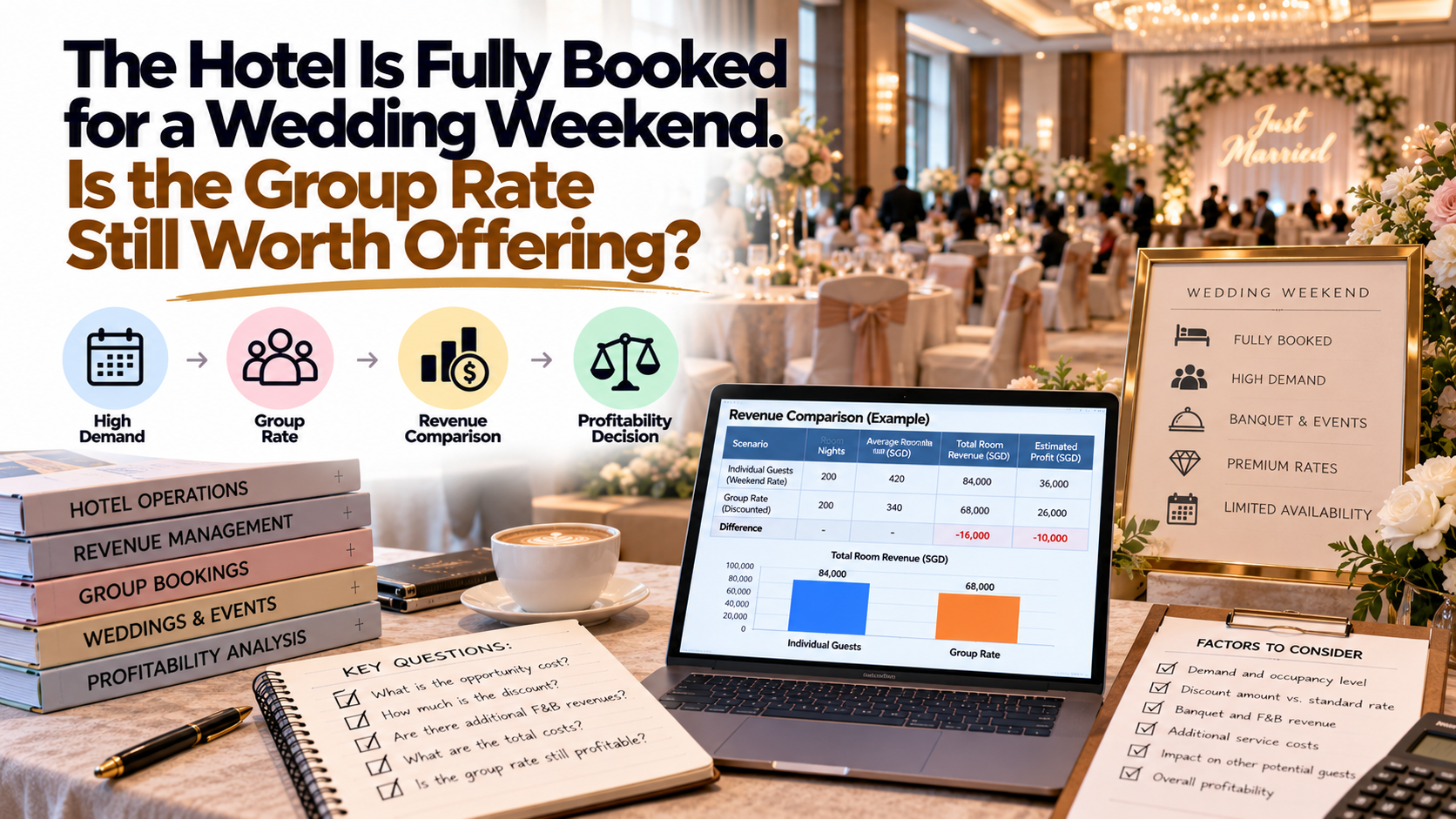
The reservations calendar looks encouraging. A wedding party has requested a large room block, the ballroom is reserved, and the sales team expects additional spending on meals and drinks. With the hotel approaching full occupancy for the weekend, accepting the group rate may seem like an obvious success.
Yet a full hotel does not automatically mean the hotel has made the best commercial decision. Discounted rooms, complimentary upgrades, extended checkout times and extra staffing can change the value of the booking. The question is whether the wedding business contributes enough after considering the costs and other bookings it may displace.
Gekonnt’s accounting services include financial analysis and advisory support. For hotel owners, the value of clearer financial information lies in connecting an attractive sales proposal to its effect on earnings and cash. A wedding package deserves that assessment before the room rate and complimentary benefits become binding commitments.
Start With What “Fully Booked” Actually Means
There is an important difference between a hotel that is already fully booked and one that expects to become fully booked after accepting a wedding group. In the first situation, the hotel may have little remaining inventory to offer. In the second, management is comparing the certainty of a group reservation with the possibility of selling those rooms elsewhere.
There is also a difference between rooms held provisionally and rooms firmly committed. A large block can make the reservations calendar appear full even though guests have not confirmed their individual stays. The hotel needs to know which rooms are guaranteed, which can be released and when that release will happen.
If a group rate has already been contractually agreed, management should assess performance and any permitted changes within those terms. The opportunity to improve pricing may apply to additional rooms or future events rather than the existing commitment. A later increase in public room rates is not, by itself, a reason to disregard an agreed booking.
Compare the Booking With a Realistic Alternative
A public room rate is an asking price, not proof that every room would sell at that price. Before treating the group discount as lost income, examine booking pace, comparable weekends, cancellations and the remaining time available to sell. A busy holiday weekend may present a different alternative from an ordinary weekend with little demand.
The comparison should consider the contribution each option is expected to generate. Costs that change because of the booking matter, as does the contribution from business the hotel would genuinely give up. Existing costs that remain unchanged under both options should not be treated as additional costs of accepting the group.
Room type matters as well. A wedding party requesting standard rooms may leave premium inventory available for other guests. A package requiring suites, connecting rooms and early access to an entire floor creates different constraints. Management needs a view of the actual inventory requested, rather than a single percentage discount applied across the hotel.
A Room Block Can Look Better or Worse Depending on Demand
Consider a simplified hypothetical example, not a Gekonnt client case. A wedding group requests 40 rooms for two nights, creating 80 room nights, at S$220 per room night. Room revenue would be S$17,600. Assume incremental servicing costs of S$50 per occupied room night, giving S$4,000 in costs and S$13,600 in room contribution.
Suppose the hotel reasonably expects to sell 60 of those room nights to other guests at S$300, with S$25 in distribution costs and S$50 in servicing costs per room night. That alternative would contribute S$13,500. On those assumptions, the wedding block contributes S$100 more before event benefits and additional group costs.
However, if the hotel expects to sell all 80 room nights on the same alternative terms, their contribution becomes S$18,000. The wedding block would then generate S$4,400 less in room contribution. The same group rate produces a different decision because the expected alternative has changed.
These figures exclude taxes and service charges and are used only to illustrate a management comparison. A hotel should use consistent figures and its actual cost assumptions. The group also needs to materialise as expected; an unguaranteed block of 80 room nights should not automatically be treated as 80 paid room nights.
Include the Wedding Revenue That Depends on the Room Offer
A room discount may help secure a profitable banquet, welcome dinner or farewell breakfast. Those connections should be considered, but they need to be established. Ask whether the event booking genuinely depends on the accommodation offer or whether the couple would book the ballroom regardless.
If the banquet would take place under either option, its contribution belongs in both scenarios and does not explain why a room discount is worthwhile. If the hotel would lose the entire event without an acceptable accommodation package, the linked contribution becomes relevant to the comparison.
Even then, banquet revenue is not the amount available to offset discounted rooms. Food, beverages, temporary staff, external equipment and other event costs must be considered. The event space may also have another credible use that weekend. Counting the full banquet invoice while ignoring its delivery costs creates an overly favourable picture.
A shared booking reference across accommodation, catering and event charges can help finance assemble the complete picture. It also makes it easier to identify whether an apparent room discount has been offset by profitable event activity or simply accompanied by more discounted services.
Give Complimentary Benefits a Financial Value
A wedding package can accumulate concessions during negotiation. Two complimentary rooms become four, a standard suite becomes a premium suite, and breakfast is added for guests who were initially booking room-only. Each request may appear manageable when approved separately.
Together, those concessions can materially change the booking. Complimentary occupied rooms still require servicing, meals still require ingredients and labour, and transport still needs to be provided. Some benefits also reserve capacity that could otherwise be sold.
The treatment should reflect the circumstances. An upgrade into a suite that would probably remain empty has a different financial effect from an upgrade that prevents a confirmed premium booking. Avoid assigning every benefit an inflated brochure value, but do not assume that a benefit is costless because the customer does not pay separately for it.
Keep one approved record of the package, including concessions added after the original quotation. Reservations, front office, catering and finance should work from that same version. Otherwise, the final contribution can deteriorate through promises that never reach the pricing review.
Check the Pressure on Staff and Facilities
A wedding group can concentrate activity into a few demanding hours. Guests may arrive together, request early room access, order breakfast at the same time and leave shortly after the event. Normal weekend staffing may not be sufficient even if total occupancy is familiar.
Speak with the teams responsible for delivery before confirming the package. Housekeeping may need additional attendants, the restaurant may need another breakfast service area, and front office may require extra coverage. These are practical scheduling questions that can become financial surprises if addressed only after the booking is signed.
Shared facilities deserve attention too. A private gathering may restrict access to a lounge, while event preparation may occupy a restaurant area normally available to other guests. Where additional costs or foregone sales can be reasonably estimated, include them in the comparison.
Some service risks cannot be reduced to a precise number. Management should still identify them and decide whether staffing or package changes can address them. A forecast that assumes flawless delivery without the necessary resources is not a useful basis for approval.
Negotiate the Structure as Well as the Rate
The hotel does not have to choose only between accepting the proposed discount and rejecting the wedding business. A smaller initial room block, different rates by night or a limit on premium room types may produce a more workable arrangement.
For example, Friday may have weaker demand while Saturday is already selling strongly. A single discounted rate across both nights can conceal that difference. Separate nightly pricing allows the offer to reflect the inventory being committed.
Release dates and booking guarantees also affect the commercial value. A provisional block held until shortly before arrival leaves less time to resell unused rooms. Management should understand that exposure and negotiate clear arrangements for unbooked inventory, cancellations and payment.
The agreed terms need to be documented and reviewed appropriately. Finance can model the consequences of different options, while the people responsible for the contract establish what the parties actually agree. A favourable spreadsheet assumption is of little help if it never appears in the final arrangement.
Separate the Cash Schedule From the Earnings Forecast
A deposit can improve the bank balance well before the wedding weekend, but management still needs to map the payments required to deliver the event. External vendors, temporary staffing agencies and suppliers may require payment before the hotel collects the final customer balance.
Prepare a dated cash schedule alongside the contribution forecast. Show customer instalments, supplier payments and any remaining collection after the event. This makes a funding gap visible even where the booking is expected to be commercially attractive.
Clarify who pays each charge. The couple may cover the banquet while individual guests settle their rooms and incidentals. A master account should specify which charges it accepts, with staff instructions that match the agreement. Unclear billing responsibilities can turn a successful event into weeks of disputed collections.
Review the Booking Across Departments
Separate departmental targets can encourage incomplete decisions. The accommodation team may focus on room revenue, the events team on banquet sales and operations on staying within staffing budgets. Each measure has a purpose, but none alone establishes whether the overall package was worthwhile.
A combined review should show expected room contribution, linked event contribution, concessions, additional delivery costs and the realistic alternative business. It should also identify uncertain assumptions, such as room pickup or additional guest spending, so that approval does not depend on unexamined optimism.
Gekonnt’s financial analysis and advisory support connects naturally to this need for decision-useful accounting information. Reliable records allow management to compare the proposal with actual results and understand why the outcome differed. Hotel management still supplies the demand judgement and operational knowledge that give the figures context.
Use the Completed Wedding to Improve the Next Offer
After the event, compare the approved forecast with the actual booking. Review room nights used, rates collected, complimentary stays, staffing costs, banquet spending and outstanding balances. The aim is to understand the result rather than simply confirm that the hotel was busy.
Look for causes that can be addressed. Perhaps the group used fewer rooms than expected, late checkout created additional housekeeping costs, or unapproved benefits reduced contribution. Alternatively, the package may have generated strong additional spending with limited extra cost.
Record those findings while the details are still available. Over several events, the hotel can build evidence about which package structures work, which promises create pressure and which assumptions repeatedly prove too optimistic. That evidence is more useful for future negotiations than a general belief that wedding groups are always valuable.
Make Full Occupancy Earn Its Place
A discounted wedding block can be a sound decision when it fills rooms that might otherwise remain empty or secures worthwhile additional business. It can also be expensive when it displaces stronger demand and brings substantial concessions or delivery costs. Occupancy alone cannot distinguish between those outcomes.
Before approving the next package, bring the room forecast, event contribution, operational requirements and payment schedule into one review. Decide which assumptions need evidence and which terms would make the offer acceptable. This gives the sales team a clear basis for negotiation.
Speak with Gekonnt about its accounting, financial analysis and advisory support if management needs clearer information behind commercial decisions. With consistent records and a complete view of the booking, hotel owners can judge whether a full wedding weekend is also a financially worthwhile one.