
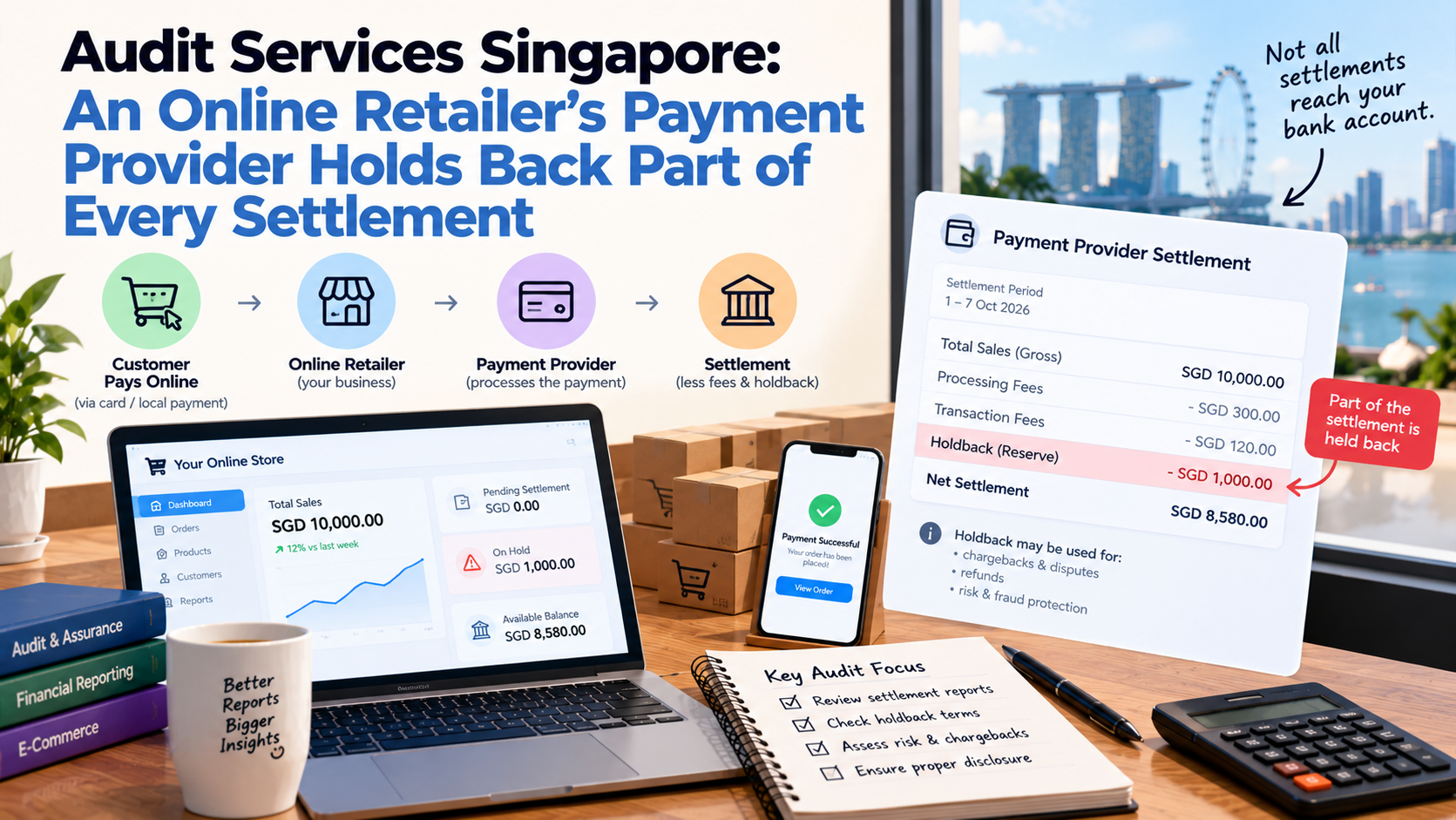
An online retailer records another strong sales week, but the payment arriving in its bank account is smaller than expected. Processing fees explain part of the difference. The payment provider has also retained a percentage of the collections as a reserve, with the funds expected to become available later.
As sales increase, the reserve grows. Management can see the amount on the provider’s dashboard, but the accounting records may not clearly distinguish it from ordinary settlement balances, fees or available cash. At year-end, the retailer must explain what remains recoverable, when it may be released and which deductions have already affected it.
Gekonnt provides financial statement audit services in Singapore. For online retailers preparing for an audit, withheld payment reserves require more than a screenshot of the latest balance. The supporting records should connect the provider’s terms, transaction movements and release history to the amount reported in the accounts.
Understand What the Provider Is Holding
Payment providers can retain funds to cover potential refunds, chargebacks and other exposures under their agreements. A reserve may involve a percentage of transactions held for a period, a fixed amount or another arrangement specified by the provider.
The retailer should identify the arrangement that actually applies to its account. A general help page may explain the concept, but the merchant agreement and account-specific notices establish the relevant terms.
Distinguish reserved funds from ordinary payments awaiting settlement. A pending balance may relate to the provider’s normal processing cycle, while a reserve carries additional release conditions. Treating both as a single overdue balance can create misleading ageing information.
Keep the latest notice together with earlier versions. If the provider changes the withholding percentage or release arrangements, finance needs to know when the change took effect and which transactions it covers.
A Reserve Is Not Automatically a Processing Expense
A deduction from a payout does not necessarily represent a cost. Where the retailer retains a supported right to receive the withheld amount, recording it immediately as a processing expense may understate assets and profit.
Equally, the amount should not automatically be treated as unrestricted cash simply because it appears in the provider’s dashboard. Its classification depends on the contractual rights, access restrictions and applicable accounting requirements. A receivable from the provider may be appropriate in some arrangements, but the facts need assessment.
Separate the questions of classification and recoverability. Establishing that a balance represents an asset does not prove that its full recorded amount will be recovered. Conversely, a contractual holding period does not, by itself, establish that the asset has been lost.
Management should document the basis for its treatment. The explanation should identify what the company is entitled to receive and the conditions affecting access to it.
Separate Customer Sales From Provider Settlements
The provider’s payout is a settlement figure, not a complete sales report. It may combine collections from several days and deduct fees, refunds, disputes and reserves before transferring the remainder.
Start with the underlying customer transactions and assess their accounting separately. Customer collections may include payments for goods not yet delivered, so the amount processed is not automatically the period’s revenue.
Then reconcile the movement through the provider account. This allows finance to distinguish the customer transaction from the later transfer of money into the company’s bank account.
Recording only the net bank deposit as sales can omit both balances and costs. The retailer needs a clear link between its order records, payment-provider reports and ledger, with each stage serving its own purpose.
An Illustrative Settlement Reconciliation
Consider a hypothetical retailer whose provider processes S$100,000 of customer collections during a settlement period. Assume the report identifies S$3,000 in processing fees, S$5,000 in customer refunds and S$10,000 transferred into reserve. The resulting bank payout is S$82,000.
The S$18,000 difference between collections and the payout is not one accounting item. The fees, refunds and withheld reserve each require separate treatment, supported by their underlying records.
Now assume the reserve started the period at S$20,000. During the period, the provider added the S$10,000 withholding, released S$6,000 into the available balance and applied S$2,000 against separately identified chargebacks. The closing reserve would be S$22,000.
These figures exclude tax, foreign exchange movements and other adjustments. They are illustrative rather than a description of any provider’s pricing. The S$2,000 reserve-funded chargebacks are also separate from the S$5,000 refunds in this example, which avoids counting the same deduction twice.
The reconciliation explains how the closing balance arose. It does not, by itself, settle the accounting for each chargeback or establish that every remaining amount is recoverable.
Build a Reserve Movement Schedule
A useful reserve schedule should show the opening balance, new amounts withheld, releases, deductions and closing balance. Reconcile it to the provider’s report and the corresponding ledger account for the same date.
Where the arrangement uses rolling release periods, track the withheld amounts by transaction date or release group. A single total does not show which funds are expected to become available next or which have remained restricted longer than planned.
Separate movements between reserved and available provider balances from actual bank payouts. Funds may be released from reserve but remain with the provider until the next settlement. Recording the release as cash received too early can create another reconciliation difference.
Retain transaction identifiers and report references so material movements can be traced. This is particularly useful when the provider’s export combines several adjustment types under similar descriptions.
Track Release Conditions, Not Just Expected Dates
A forecast release date may be subject to conditions. The provider may require an account review, resolution of disputes or continued coverage of specified exposures. Finance should understand whether the date is contractual, estimated or conditional.
Record the relevant conditions and supporting correspondence. If the provider extends the holding period, obtain the explanation and review its implications rather than simply moving the expected receipt date forward in the spreadsheet.
Age the balance against the actual arrangement. Funds held within an agreed period are different from amounts that should have been released but remain unpaid. Both need visibility, but they do not represent the same issue.
Assign responsibility for follow-up. The person managing the payment account may receive notices that finance never sees. A defined handover helps ensure changes reach the accounting records and cash forecast promptly.
Review Chargebacks and Refunds Separately
A reserve deduction may settle a customer refund, cover a chargeback or reflect another adjustment. Its accounting depends on the underlying event, not merely the fact that the provider took money from the reserve.
Link each material deduction to the customer order and dispute record. Establish whether the amount is final, still contested or subsequently reversed. Where the retailer is challenging a chargeback, retain the status and evidence rather than assuming recovery.
Check whether the same customer matter has already been recorded elsewhere. A refund recognised through the order system and a deduction imported from the provider can duplicate the accounting effect if the records are not matched.
Keep provider fees associated with disputes separately identifiable where relevant. This helps management distinguish the customer amount from the additional cost of processing or contesting the case.
Assess Recoverability Using Current Evidence
The provider’s dashboard supports the reported balance, but management still needs to assess its rights and expected recovery. Review subsequent releases, unresolved deductions, account restrictions and correspondence concerning withheld funds.
Where the balance is a financial asset subject to expected-credit-loss requirements, the assessment should consider relevant forward-looking information. It should not be postponed until a provider has definitively failed to pay.
Distinguish provider credit risk from deductions relating to the retailer’s own customer transactions. A valid refund applied against the reserve is not automatically a credit loss caused by the payment provider. The two matters require separate analysis.
Avoid both extremes: assuming every reserve is fully recoverable because it is described as temporary, or writing it down solely because access is restricted. The conclusion should reflect the evidence, contractual position and applicable reporting requirements.
Preserve Evidence for Audit Services Singapore Reviews
For retailers seeking audit services Singapore businesses rely on, reserve preparation should include the merchant agreement, account-specific notices, dated balance reports and transaction exports. These records help explain the nature and movement of the reported amount.
A screenshot can be useful, but it may omit the reporting date, currency, account identity or detailed movements. Retain downloadable reports and reconciliation schedules where available, rather than relying on a live dashboard that changes after year-end.
Keep records for each relevant merchant account and legal entity. A combined operational dashboard may include several stores or companies, while the financial statements cover only one entity.
Gekonnt’s financial statement audit services provide independent examination of financial reporting. Management remains responsible for complete records and accounting assessments. Organised evidence gives the engagement a clearer starting point without replacing the auditor’s own procedures.
Follow Releases Through to the Bank
A reserve release should be traced through the available provider balance and into the relevant payout where applicable. Matching only the release notice can leave the final receipt unverified.
Subsequent receipts can provide evidence about year-end balances, but the link needs to be established. A January payout may combine released reserves with new customer collections. Its total should not automatically be treated as recovery of the entire December balance.
Explain partial releases and deductions. If the provider releases less than the schedule predicted, identify whether the difference arises from timing, a changed condition or an adjustment requiring separate review.
Keep the original year-end schedule and document later developments alongside it. Updating the schedule without preserving its earlier state can make it difficult to understand what was recorded at the reporting date.
Keep Reserved Funds Out of Immediate Spending Assumptions
Sales growth can increase the reserve balance and reduce the proportion of collections available for day-to-day use. A retailer may therefore need more working capital even while orders and reported earnings improve.
Build the cash forecast using expected available payouts, with reserve releases shown separately. Include realistic timing and distinguish confirmed releases from estimates that depend on further review.
Test the effect of slower releases or a higher withholding percentage where those are credible risks for the account. The purpose is to understand whether supplier payments, fulfilment costs and payroll remain funded if access to collections changes.
Do not present restricted funds as though management can draw on them immediately. A supported asset balance and an available source of short-term cash are different considerations.
Investigate Balances Left Behind After Switching Providers
Changing payment providers does not necessarily close the old reserve account. Funds may remain subject to the original arrangement while refunds or disputes continue to arise.
Keep access to reports and correspondence for the old account. Assign someone to monitor releases, deductions and outstanding enquiries until the balance has been resolved.
Reconcile any final settlement rather than assuming that the account closure notice explains every movement. Review fees, adjustments and amounts still disputed, and retain evidence of the final position.
The same discipline applies when closing an online store. Operational closure does not eliminate the need to track assets and obligations linked to earlier transactions.
Make Reserve Reporting Part of the Monthly Close
A monthly review should explain the reserve balance, expected release profile and significant exceptions. Reconcile each provider account and investigate differences while the underlying orders remain easy to locate.
Use consistent descriptions for withholding, releases and deductions. Changes to provider exports or accounting integrations should be checked so that new transaction types do not disappear into miscellaneous accounts.
Management should receive an explanation when the reserve grows faster than collections or releases fall behind expectations. The cause may be straightforward, but the effect on reporting and cash planning deserves attention.
Gekonnt’s audit work connects to the need for supported financial statements. A regular reconciliation process helps the retailer present understandable balances and reduces the amount of reconstruction required at year-end.
Explain What Remains With the Provider
Withheld settlements are not automatically lost revenue, processing expenses or available cash. The retailer needs to establish the underlying rights, reconcile movements and assess what it expects to recover.
Before closing the accounts, review reserve terms, trace significant deductions and check subsequent releases. Keep uncertainty visible and separate contractual holding periods from unexplained delays.
Speak with Gekonnt about its audit services Singapore offering and the evidence relevant to your payment arrangements. Clear reserve schedules and documented assessments help explain the funds still held by providers and their effect on the retailer’s financial position.