
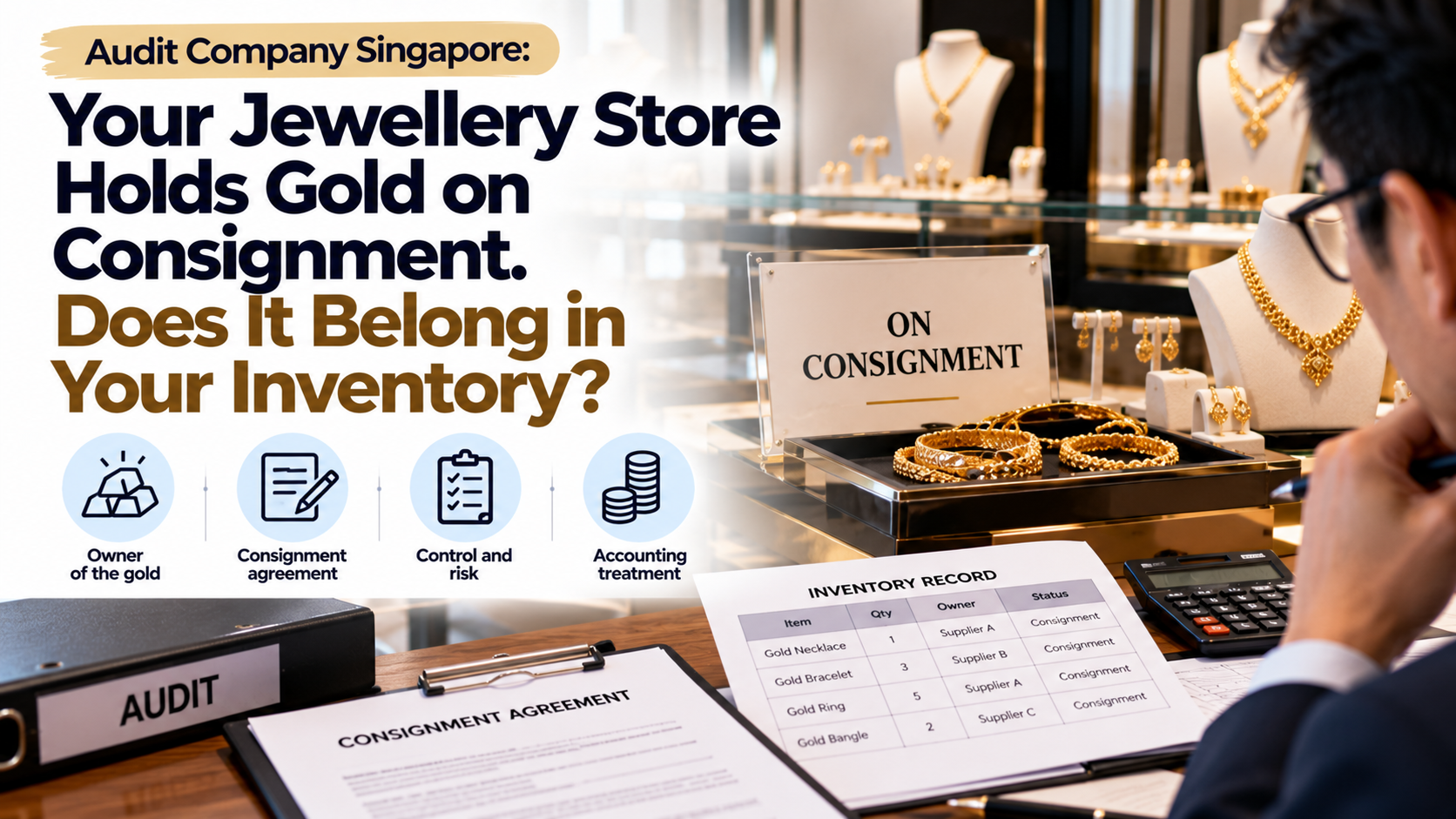
Your jewellery store’s display cabinets contain pieces purchased from suppliers alongside items delivered on consignment. Customers see one collection, and your staff may use the same stock system to track everything. When year-end arrives, it can feel natural to include every piece in the store’s inventory balance.
However, physical possession does not automatically establish that an item belongs in your company’s inventory. In a genuine consignment arrangement where the supplier retains control, the unsold jewellery generally remains the supplier’s inventory. Your store still needs to track and safeguard it, but that is different from recognising it as its own asset.
For a retailer looking for an audit company Singapore businesses can work with, this distinction is worth understanding before the audit begins. The practical task is to connect each category of jewellery to its commercial terms, stock records and accounting treatment.
Start With the Arrangement, Not the Label
A delivery note marked “consignment” is a starting point, rather than a complete accounting conclusion. Management needs to understand the substantive rights and obligations in the agreement.
Under the consignment guidance in IFRS 15 and the corresponding full Singapore revenue standards, relevant indicators include the supplier retaining control until a specified event, having the ability to require the goods’ return or transfer, and the dealer lacking an unconditional obligation to pay. No single label substitutes for assessing the arrangement.
Discuss the agreement with the finance team before setting up the supplier in your system. Establish what happens when goods arrive, when a customer buys a piece and when unsold items are returned. Where terms are unclear, obtain clarification rather than relying on how the sales team describes the relationship.
A company may have several arrangements with the same supplier. Some pieces might be purchased outright, while others are supplied for a temporary exhibition. Treating the supplier’s entire account as one category can create errors even when the individual documents are available.
Separate the Physical Stock Register From the Accounting Balance
Your store needs an operational record of everything it holds. That includes purchased jewellery, consigned pieces and customer items left for repair. The financial inventory balance should be drawn from the appropriate categories within those records.
Use a clear status field to distinguish the categories. Each piece should have a reference that connects it to its supporting documents, rather than relying on employees to remember which items came from which supplier. High-value items deserve particularly clear identification.
Record details that make the item distinguishable, such as its tag number, description, weight, purity and relevant stone information. The appropriate level of detail depends on the product, but a description such as “gold bracelet” may be insufficient where several similar pieces are held.
These records serve different purposes. The physical register helps the store account for custody, while the accounting schedule explains the assets recognised in the financial statements. Keeping the two connected allows management to explain why the total value of everything in the cabinets differs from the reported inventory balance.
Make the Year-End Count Ownership-Aware
A count can establish that a piece is present without resolving its accounting category. If staff combine purchased and consigned items on the same count sheet without identifying their status, finance may have to reconstruct the distinction later.
Prepare count instructions that require the relevant category and item reference to be recorded. Include jewellery in the safe, items held for customer viewing and pieces temporarily removed from the display. Returned or damaged items should remain visible in the records rather than disappearing into a separate drawer.
Consider a hypothetical store with 300 identified pieces at year-end. Its records show that 180 were purchased outright, 100 are held under genuine supplier consignment arrangements and 20 belong to customers awaiting repairs. Assuming those classifications are supported, all 300 belong in the custody records, but the store’s own jewellery inventory consists of the 180 purchased pieces.
The example concerns classification, not valuation. Finance still needs to establish the appropriate carrying amount of the recognised inventory. Multiplying every piece counted by an estimated selling price would answer neither question correctly.
Reconcile Consigned Items With Each Supplier
Prepare a separate movement schedule for each consignment supplier. Start with the opening quantity, add deliveries and deduct customer sales and returns to the supplier. Explain other movements, including transfers between branches or items sent for alteration.
For example, a supplier’s schedule might begin with 60 pieces, show 25 received during the period, 18 sold and seven returned. The expected closing quantity is 60 pieces. If the store can locate only 58, the difference needs investigation rather than an unsupported adjustment to make the schedule agree.
Check whether both parties are using the same reporting date and item references. A return dispatched before year-end may reach the supplier afterwards, while a sale may appear in the store’s system before the supplier receives its monthly report. Preserve the documents explaining those differences.
A reconciled supplier statement provides a useful starting point for audit enquiries. It also helps management identify unreported sales, duplicated deliveries and unresolved returns before they become long-standing disputes.
Review Sales and Supplier Settlements Separately
Once a consigned piece is sold, the store needs to record the transaction according to its role. Gross-versus-net revenue depends on whether it controls the specified goods before transfer to the customer or instead arranges their supply. Consignment stock at receipt does not, by itself, settle that assessment at the point of sale.
The practical records should therefore show both the customer transaction and the amount due to the supplier. Avoid assuming that every receipt through the till is wholly the store’s revenue.
Suppose, in a simplified example, the documented arrangement establishes that the store acts as an agent. A customer pays S$5,000, the supplier is entitled to S$4,500 and the store earns a S$500 commission. Ignoring taxes and other charges, the store records its S$500 revenue and the S$4,500 payable to the supplier, rather than S$5,000 of revenue.
That example should not be copied into every consignment arrangement. The conclusion must reflect the actual terms. Its purpose is to show why cash collected, revenue earned and money owed to a supplier can be different amounts.
Do Not Wait for the Supplier’s Invoice to Review Completed Sales
Supplier billing may lag behind customer sales. A piece sold in late December might not appear on a supplier’s settlement statement until January, particularly where reports are prepared monthly.
Create a year-end schedule of completed sales that have not yet been settled or invoiced by the supplier. Include the sale date, item reference, customer amount and contractual supplier entitlement. Finance can then assess the appropriate entries using the transaction evidence rather than the invoice arrival date alone.
Also distinguish completed sales from reservations. A customer deposit, an item set aside for collection and a delivered piece can represent different stages of a transaction. Keep those statuses clear so that the same piece is not treated as both unsold consignment stock and a completed sale without explanation.
Where returns or cancellations occur around year-end, connect them to the original transaction. Management needs to understand whether the item returns to supplier-controlled stock, becomes the store’s responsibility or requires another treatment under the agreement.
Treat Deposits and Guarantees as Separate Questions
A supplier may ask for a security deposit before releasing valuable jewellery. That payment needs its own assessment; it should not automatically be treated as the purchase price of all items subsequently delivered.
Keep the deposit agreement, payment evidence and any conditions governing refund or deduction. Establish whether the amount is refundable, applied against future settlements or subject to other restrictions. Record changes when the supplier uses part of the deposit, rather than leaving the original amount unchanged indefinitely.
Likewise, understand any obligation to compensate the supplier for missing or damaged goods. An item excluded from the store’s inventory can still expose the business to a payment obligation. Insurance arrangements and custody responsibilities therefore remain commercially important.
Avoid netting unrelated balances merely because they involve the same supplier. A deposit, a settlement payable and an unresolved claim should remain identifiable so that finance can assess their presentation and treatment appropriately.
Keep Gold Prices Separate From the Ownership Question
A rise in the gold price does not turn supplier-controlled jewellery into your company’s asset. Establish which goods belong in the inventory balance before considering their value.
For ordinary retail jewellery inventory under the applicable full Singapore reporting framework, the general measurement basis is the lower of cost and net realisable value. A higher quoted gold price does not normally justify writing ordinary retail inventory above cost. Specialised commodity broker-trader treatment should not be assumed simply because the products contain gold.
Jewellery valuation also requires attention to the actual product. Ageing designs, damage, selling costs and expected discounts may affect recoverability. Metal content alone may not capture the economics of selling a finished piece.
Keep the valuation review focused on the inventory the store recognises. Separate supplier price references used for custody or insurance from the carrying amounts used in the accounts, so that figures prepared for different purposes are not mixed together.
Prepare Documents That Explain the Arrangement
A useful audit file brings together the consignment agreements, item-level records, count results and supplier reconciliations. Add settlement calculations and explanations of significant differences so that the relationship between stock movements and accounting entries is traceable.
Where agreements have changed, retain the relevant versions and effective dates. A supplier may revise return rights, payment deadlines or pricing arrangements during the year. The finance team needs to know which terms applied to the items and transactions being reviewed.
Make the source of each figure clear. A supplier’s stated retail value, an insured value and the amount payable on sale may all appear in correspondence, but they serve different purposes. Label them accurately rather than presenting an unexplained “stock value”.
When selecting an audit company, Singapore jewellery retailers should discuss significant consignment arrangements early. That gives the audit team time to consider the evidence required and gives management time to retrieve documents from suppliers.
Resolve Missing Pieces Before They Become Recurring Adjustments
A shortage involving consigned stock needs investigation even when the item is excluded from your inventory asset. It could represent an unrecorded sale, an undocumented branch transfer or a custody issue requiring further action.
Assign responsibility for investigating each difference. Check sales records, movement logs, repair records and return acknowledgements before concluding what occurred. Document the outcome and any accounting or operational action taken.
Repeated discrepancies may indicate a process weakness. For example, staff might remove items for customer viewing without recording the movement, or sales may be reported to suppliers through a spreadsheet that is not reconciled to the till system.
Management should address those causes rather than relying on periodic adjustments. Clear records protect the quality of the financial information and make discussions with suppliers more straightforward when questions arise.
Give Management a Clear View of What the Store Holds and Owes
A jewellery store can hold substantial value without owning every piece in its cabinets. Its reporting should distinguish goods purchased by the business, goods held for suppliers and customer property. It should also identify sales proceeds awaiting settlement and deposits or claims that need separate attention.
Review these schedules regularly instead of assembling them only at year-end. Staff changes, item transfers and delayed supplier statements are easier to manage when the records are maintained throughout the year. Management remains responsible for the accounting conclusions and the supporting information.
Gekonnt PAC provides financial statement audit services in Singapore. For a jewellery retailer with significant consignment arrangements, sharing the contracts and reconciliations early can help the audit team understand the business and plan its work.
The starting question is whether the store controls the goods under the actual arrangement. Once that is established, the stock records, sales reporting and supplier balances should tell a consistent story. That gives management a sounder basis for explaining both the jewellery in its care and the amounts in its financial statements.