
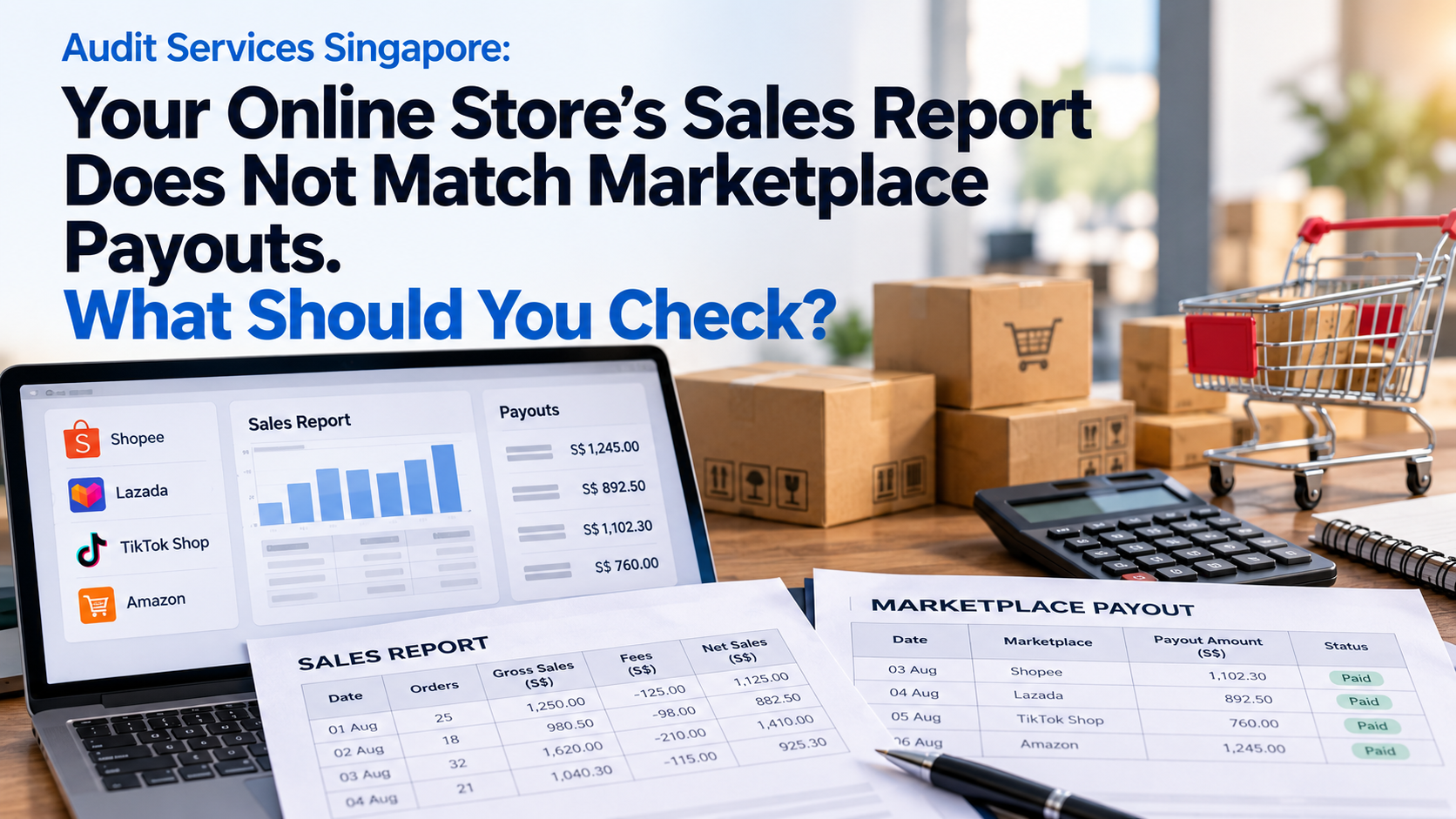
Your online store’s dashboard shows S$100,000 in sales for the month, but the marketplace transfers considerably less to your bank account. The operations team points to platform fees and refunds. Finance suspects some sales have not yet been settled. Management wants to know whether the difference is normal or whether money is missing.
For an e-commerce business, comparing dashboard sales directly with bank receipts rarely provides the full answer. Those figures may represent different transactions, different periods, and different stages of the settlement process.
If you are preparing for an audit or comparing providers of Audit Services Singapore, a clear marketplace reconciliation is a useful starting point. It connects order activity, accounting records, platform deductions, outstanding settlements, and bank receipts so that each difference can be explained.
Start by Understanding What the Sales Report Measures
A report labelled “sales” may show orders placed, orders paid, goods dispatched, or completed transactions. It may include amounts that are later cancelled, refunded, or adjusted. Before using the total in your accounts, establish what the report actually contains.
Check whether the figure includes delivery charges, taxes, vouchers, and unpaid orders. Review the date filter and whether transactions are grouped by order date, completion date, or another event. Reports from different platforms may use different definitions.
For example, an order placed on 30 September may be delivered in October and included in a later settlement. Its appearance in September’s order report does not, by itself, determine September’s accounting revenue or cash receipts. Document the report definitions before trying to explain the difference between the totals.
Distinguish Revenue From the Money Received
Revenue recognition and cash collection answer different questions. Under the revenue principles in IFRS 15 and its Singapore equivalents, recognition reflects the transfer of promised goods or services and the consideration the business expects to receive. The applicable framework and contract terms need to be considered.
A marketplace payout represents a settlement of amounts through the platform. It may combine receipts relating to earlier sales, deduct current charges, and leave other amounts unsettled. Consequently, the payout is not automatically the correct revenue figure.
Avoid recording every bank receipt from the marketplace directly as sales without understanding its components. That approach can obscure platform expenses, refunds, and amounts still owed to the business. It can also make monthly performance appear to depend on payout timing rather than trading activity.
Compare the Same Period and Transaction Population
Before investigating missing money, make sure the reports cover comparable activity. A calendar-month sales report and a payout covering several settlement batches will not necessarily contain the same orders.
Identify the transactions behind each payout using the platform’s settlement references and order identifiers. Where possible, connect each settlement batch to the relevant bank receipt. Note any settlement that has been issued by the platform but has not yet reached the bank.
Check reporting time zones and currency settings as well. An export using one time zone may place transactions on a different date from an internal report. These differences should be understood and documented rather than repeatedly corrected without explanation.
Build a Bridge From Opening Balance to Closing Balance
A useful reconciliation begins with the amount unsettled at the start of the period. It then explains additions, deductions, cash received, and the balance remaining at the end.
Consider this simplified hypothetical example, with GST and foreign exchange excluded:
Opening amount due from marketplace: S$12,000
Add eligible sales credited during the month: S$100,000
Less refunds deducted during the month: S$5,000
Less platform fees deducted during the month: S$8,000
Less payouts received in the bank: S$90,000
Closing amount due from marketplace: S$9,000
The S$100,000 sales credit and S$90,000 bank receipt are different, but the movement can be explained. This is an illustrative settlement reconciliation, not a complete revenue calculation. Actual reports may include reserves, advertising charges, taxes, or other adjustments requiring separate lines.
Check that each movement appears only once. If the platform’s starting sales figure is already net of refunds or fees, deducting them again would create another error.
Separate Platform Fees From Sales Adjustments
A deduction from a payout does not automatically reduce revenue. Depending on the arrangement, commissions, payment-processing fees, advertising charges, and fulfilment services may represent expenses rather than reductions in customer sales.
Start by establishing your company’s role in the sale. Where the business is principal for the goods supplied, the fact that the marketplace deducts its fee before settlement does not by itself justify reporting only the net cash receipt as revenue.
Review the platform agreement and the nature of each charge with your accountant. The principal-versus-agent assessment depends on the specified goods or services and control, rather than who collects the customer’s money. Apply the resulting policy consistently across the settlement records and ledger.
Find Out Who Funds Each Discount
Promotions can make the relationship between order value and seller proceeds harder to follow. A discount may be funded by your store, the platform, or both, and the settlement report may describe the amounts differently from the customer invoice.
Suppose an item is advertised at S$120 and the customer pays S$100 after a voucher. Establish whether your business bears the S$20 reduction or is entitled to receive some or all of it from the platform. Read the campaign terms and reconcile the actual settlement.
Do not apply one accounting rule to every line labelled “voucher” or “subsidy.” The contractual arrangement determines what the amount represents. Keep the terms for significant campaigns so that finance can explain the treatment after the promotion has ended.
Trace Refunds Back to the Original Orders
Refunds may be deducted in a different month from the original sale. They may also be partial, relate to delivery charges, or arise from a dispute rather than a returned product.
Link each refund to its original order and identify the reason, approval, amount, and settlement date. Check whether the accounting system has already processed the adjustment through another integration or credit-note workflow.
For example, customer service may record a refund in the order system while finance separately imports the marketplace deduction. Without a common reference, the business could recognise the same adjustment twice. A consistent order-level link helps prevent duplication and makes later audit enquiries easier to answer.
Review Returns Separately From Cash Refunds
The financial effect of a return is not limited to the money repaid. Management also needs to understand whether the goods have been received, their condition, and how the inventory records have been updated.
An item refunded in full may still be in transit to the warehouse. Another may have arrived damaged and be unsuitable for resale. Neither situation should be resolved simply by reversing the original sale and automatically restoring the product to saleable stock.
Coordinate customer service, warehouse, and finance records. Your accountant should also assess any required year-end accounting for expected returns under the applicable framework. The platform’s completed-refund report alone may not capture all relevant obligations or inventory effects.
Identify Funds Held Back by the Platform
Some arrangements allow platforms to retain amounts while returns, disputes, or other conditions remain unresolved. The applicable terms and terminology vary, so establish what each withheld balance represents.
A held amount is not necessarily a fee or loss. Equally, it should not remain indefinitely in a receivable account without review. Record the reason for the hold, the expected release conditions, and any correspondence about recovery.
Prepare an ageing schedule for significant outstanding settlements. A balance that clears shortly after month-end presents a different question from one disputed for several months. Management should investigate older items and assess whether any accounting adjustment is necessary.
Check Delivery and Fulfilment Charges
Delivery-related entries can appear on both sides of a marketplace transaction. The customer may pay a shipping charge, the platform may deduct a fulfilment fee, and the seller may participate in a delivery promotion.
These amounts should be traced to their contractual purpose. Avoid assuming that a delivery amount collected from the customer always offsets a logistics deduction one-for-one, or that a description such as “free shipping” means the seller bears no cost.
For a representative order, compare the customer charge, campaign terms, platform settlement, and any separate logistics invoice. This can reveal costs recorded twice or amounts missing from the accounts. It also gives management a clearer view of the actual cost of serving the order.
Keep GST and Foreign Exchange Visible
If the business is GST-registered, determine whether exported figures include GST and how relevant sales, fees, refunds, and other adjustments should be treated. A dashboard total should not be used as a substitute for the required tax records.
Cross-border sales require particular care. IRAS’s e-commerce guidance distinguishes circumstances involving local sales, exports, and other arrangements. Do not assume that using an overseas marketplace or selling to a foreign customer automatically establishes the GST treatment.
Where transactions and payouts use different currencies, reconcile the original currency amounts as well as the settlement currency. Identify conversion rates, conversion charges, and exchange differences separately. Otherwise, a currency movement may be mistaken for an unexplained platform deduction.
Preserve Records Beyond Dashboard Screenshots
A screenshot may show a useful summary, but it rarely provides enough detail to reconstruct a settlement. Retain transaction-level exports, payout statements, relevant fee documents, bank records, and significant platform correspondence.
Record the export date, report period, selected filters, and account or store covered. Preserve the original files before making adjustments in a working spreadsheet. This makes it easier to distinguish source data from management’s calculations.
If you operate several stores or use multiple platforms, apply consistent file naming and ownership. Another authorised employee should be able to locate the records without depending on the person who usually downloads them. Check the platform’s data-access arrangements so that important history remains available when needed.
Use Exceptions to Direct the Review
A large store may have too many orders for management to examine individually. Build a process that identifies exceptions requiring attention while retaining a complete reconciliation.
Examples include duplicated order references, unmatched payouts, refunds without original sales, unusual deductions, and old unsettled balances. Assign responsibility for investigating each type of issue and record how it was resolved.
Do not clear an unexplained difference to miscellaneous income or expense simply to make the report agree. Establish the cause and support the resulting entry. A reconciliation that balances through an unsupported adjustment provides little confidence about whether the underlying records are complete.
Prepare a Clear Reconciliation for the Audit
The audit team may need to understand how marketplace activity enters your financial statements, what controls operate over that process, and how material balances are supported. A clear reconciliation gives the discussion a practical starting point.
Provide the accounting policy, report definitions, settlement schedules, supporting exports, and explanations of significant differences. Highlight changes in integrations, platform terms, or promotional arrangements during the year rather than assuming the previous process still applies.
Management remains responsible for preparing and maintaining the records. The annual audit does not replace regular reconciliation. Resolving issues monthly reduces the amount of information that must be reconstructed when financial statements are being finalised.
Discuss Your E-Commerce Reporting With Gekonnt
Gekonnt PAC provides financial statement audit services and independent examination of financial reports. For an online retail business, explaining the relationship between orders, recognised revenue, platform balances, and cash receipts helps the audit team understand the reporting process.
When discussing Audit Services Singapore with Gekonnt, bring examples from each significant sales channel and identify where your team encounters recurring differences. Include the relevant platform agreements and an explanation of how data is transferred into the accounting system.
A sales report that differs from a marketplace payout does not automatically indicate missing money. The important question is whether the difference can be explained with consistent records. A reliable reconciliation helps management understand what the store earned, what it spent, what it received, and what remains outstanding.