Financial Reporting in Singapore Is Becoming Increasingly Digital
For many Singapore business owners, financial statements are still viewed primarily as documents prepared at the end of the financial year. The accounts are completed, reviewed by the relevant parties, approved by directors and eventually filed as part of the company’s annual compliance obligations where required. While the underlying financial information is extremely important, the technical process used to submit that information to regulators may receive relatively little attention from management.
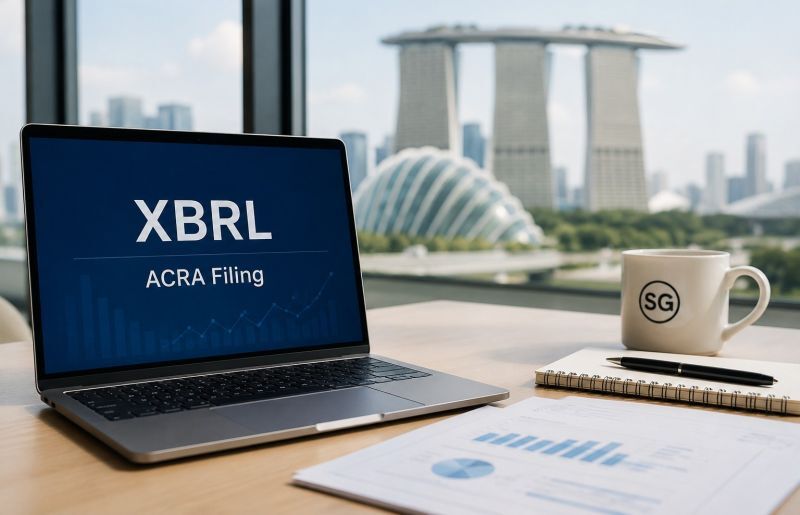
That process is becoming increasingly digital and structured. One important development in 2026 is the introduction of ACRA’s updated XBRL filing tools and ACRA Taxonomy 2026. From 25 February 2026, ACRA made new versions of its BizFinx Preparation Tool and Multi-Upload Tool available for preparing, validating and uploading financial statements in XBRL format. Entities were allowed to begin using the updated versions from that date and were required to transition to them by 15 April 2026.
For business owners who are unfamiliar with XBRL, the terminology can make the change sound more complicated than it actually is. XBRL stands for eXtensible Business Reporting Language. It is a digital format used for communicating business and financial information. Instead of financial statements existing only as documents designed for people to read, XBRL applies digital tags to individual financial items so that computers can identify and process the information as structured data.
For example, a person looking at a set of financial statements can recognise a figure labelled “revenue” or “net profit” because the meaning is presented visually in the document. Computers need a structured method of identifying what those numbers represent. XBRL provides that structure by attaching standardised digital labels to financial information. This makes it possible for systems to process and compare financial data more efficiently.
The 2026 changes therefore represent more than another software update for accountants. They are part of the continuing digitalisation of financial reporting Singapore businesses need to understand. Companies still prepare financial statements according to applicable accounting standards, and those statements still need to present a true and fair view of the company’s financial position and performance. What is changing is the digital structure through which certain companies submit that information to ACRA.
For SME owners, there is no need to become XBRL technical experts. However, understanding the basic purpose of the system can make it easier to appreciate why accurate financial records, consistent classifications and properly prepared financial statements remain important in an increasingly digital reporting environment.
What Exactly Changed in 2026?
On 25 February 2026, ACRA released updated versions of the BizFinx Preparation Tool and Multi-Upload Tool. The updated tools are used to prepare, validate and upload financial statements in XBRL format. ACRA also provides the ACRA Taxonomy 2026, which contains the taxonomy elements used when financial information is mapped into the required structured format.
The updated tools include changes reflecting developments in Singapore’s financial reporting environment. ACRA states that the latest BizFinx tools include updates relating to Financial Reporting Standard 117 for insurance companies. Eligible companies using Singapore Financial Reporting Standards with Reduced Disclosure Requirements can also select the relevant reporting option in the updated tools.
For most ordinary SME owners, however, the practical significance is simpler. Businesses and professionals preparing XBRL filings need to use the current tools and taxonomy rather than assuming that the previous process can continue indefinitely without change. The financial statements themselves remain the source of the information, but that information must be mapped appropriately into ACRA’s required digital structure.
ACRA describes its taxonomy as essentially a dictionary for XBRL. The taxonomy is based on financial statement disclosure requirements under Singapore’s accounting standards and the Companies Act 1967. It is a closed taxonomy, which means companies cannot simply create their own company-specific concepts whenever they wish. However, some presentation flexibility remains, such as customising labels and reordering concepts.
This standardisation is important because it allows financial information from different companies to be represented more consistently. Imagine two companies using slightly different descriptions for similar financial items. A human accountant may understand immediately that the terms relate to the same concept, but automated analysis becomes more difficult if every company creates its own terminology and structure. Mapping information to a standard taxonomy helps make the underlying data more comparable.
This is one reason developments in financial reporting Singapore should interest businesses beyond the finance department. As financial information becomes more structured, the quality of the underlying accounting data becomes increasingly important. Digital systems can process information quickly, but they still depend on businesses maintaining accurate records and preparing reliable financial statements.
Does Every Singapore Company Need to File XBRL Financial Statements?
One common misunderstanding is that every company incorporated in Singapore must submit exactly the same type of XBRL filing. That is not the case. ACRA’s requirements differ according to the nature and size of the company, and certain companies may be exempt from filing financial statements altogether.
In general, Singapore-incorporated companies must prepare financial statements unless they qualify as dormant relevant companies under the applicable requirements. Companies must also file financial statements with ACRA unless an exemption applies. One important exemption involves solvent exempt private companies. A qualifying solvent exempt private company does not need to file financial statements, although it may choose to file voluntarily.
For companies that are required to file, the format can differ. Smaller and non-publicly accountable companies that meet ACRA’s relevant criteria generally file Simplified XBRL financial statements together with a PDF copy of the financial statements authorised by directors. Other Singapore-incorporated companies that are required to file and do not fall within specified categories may need to submit Full XBRL financial statements. Banks, finance companies and insurance companies have specialised XBRL financial statement highlights templates, while companies limited by guarantee and certain companies using other accounting standards may have different filing requirements.
ACRA defines a smaller company for these XBRL filing purposes as one where both revenue and total assets for the current financial year do not exceed S$500,000. The assessment is based on the financial statements that the company is required to prepare under the Companies Act, with consolidated figures used in relevant situations involving subsidiaries, associates or joint ventures.
The amount of information captured also differs between the templates. ACRA states that the Full XBRL template captures approximately 210 data elements, including the primary financial statements and selected notes. The Simplified XBRL template captures approximately 120 data elements, including complete information from the statements of financial performance and financial position together with selected notes.
These differences are important because businesses should not assume that another company’s filing process automatically applies to them. The appropriate format depends on the company’s circumstances. When there is uncertainty, management should confirm the applicable requirements rather than preparing financial information according to assumptions based on another business.
What Does Mapping Financial Information Actually Mean?
One of the central activities involved in preparing XBRL financial statements is mapping. The word sounds technical, but the underlying concept is relatively straightforward. The company’s financial statements contain line items describing different parts of its financial performance and position. Those items need to be matched to the appropriate concepts within ACRA’s taxonomy.
Suppose a company’s financial statements contain revenue, employee expenses, trade receivables, property and equipment, cash balances and various liabilities. The preparer needs to identify the appropriate taxonomy concepts corresponding to those items so that the information can be represented correctly within the XBRL structure.
This process is important because companies may use different wording in their financial statements. ACRA’s guidance advises preparers to use a best-fit principle when mapping financial statement items to the taxonomy and to use “others” only for unique items that genuinely cannot be mapped to an available concept.
The requirement illustrates why XBRL is not simply a matter of copying numbers into another document. The preparer needs to understand what the figures represent and map them appropriately. Incorrect mapping could result in information being presented under the wrong financial concept even when the numerical amount itself is correct.
ACRA also requires the figures and format in the XBRL file to match the financial statements used as the source document. Its 2026 guidance highlights common issues involving rounding, currencies, presentation formats, cash flow information and accounting standards. These may appear to be small technical details, but inconsistencies can generate validation issues and delay the filing process.
For business owners, this reinforces a broader lesson about financial reporting. The reliability of financial information depends not only on having numbers available but also on understanding what those numbers represent. A transaction classified incorrectly during ordinary bookkeeping can eventually affect financial statement preparation. If problems accumulate throughout the year, year end reporting becomes more difficult regardless of how sophisticated the filing technology becomes.
The New Tools Do Not Fix Poor Financial Records
It is tempting to assume that better software automatically creates better financial reporting. Technology can certainly improve efficiency, reduce repetitive work and identify certain types of errors, but it cannot transform incomplete or inaccurate accounting records into reliable financial statements without additional work.
Consider a company that has not reconciled its bank accounts properly for several months. Customer payments may have been recorded incorrectly, supplier invoices may be missing and certain expenses may have been classified inconsistently. When the company reaches year end, those problems need to be resolved before reliable financial statements can be prepared. Using the latest BizFinx Preparation Tool does not remove the need to correct the underlying records.
The same applies to comparative information. ACRA’s current guidance notes that prior-year XBRL data can be imported in certain circumstances, but significant changes exist between older taxonomy versions and the latest versions. Not all data elements will necessarily be imported, and preparers are expected to check the accuracy and completeness of comparative figures.
This is a useful reminder that automation still requires review. A system successfully importing information does not automatically mean that every figure has been transferred exactly as required. Someone still needs to check whether the financial information is complete, accurate and appropriately classified.
For SMEs, the best preparation for year end financial reporting therefore begins much earlier than the filing deadline. Regular bookkeeping, bank reconciliations, organised supporting documents and consistent accounting treatment throughout the year can make the reporting process considerably smoother. Problems identified monthly are usually easier to investigate than problems discovered many months after the original transaction occurred.
This is particularly important as financial reporting Singapore continues becoming more digitally structured. The technology used at the final filing stage may become increasingly sophisticated, but the quality of the final output will continue to depend on the quality of the information flowing into it.
Validation Is an Important Part of XBRL Preparation
Another important feature of XBRL preparation is validation. Before the financial statements are filed, the BizFinx Preparation Tool can perform validation checks and flag errors that need attention. This allows preparers to identify potential issues before the XBRL file is submitted.
ACRA’s guidance lists several types of common errors or mismatches that preparers may encounter. These include inconsistencies in rounding levels, incorrect currency indicators, presentation format problems and missing required cash flow information. The guidance also covers situations involving discontinued operations, accounting standards and first-time consolidation.
Validation is valuable because structured financial reporting involves relationships between different pieces of information. A number may appear reasonable when viewed individually but conflict with another part of the financial statements. Automated checks can help identify these inconsistencies more efficiently than relying entirely on manual review.
However, passing validation should not be confused with proving that every accounting judgement is correct. Validation rules can check whether information satisfies certain structural and logical requirements, but they cannot replace professional responsibility for preparing appropriate financial statements. A figure can potentially be entered consistently and still be based on an incorrect accounting treatment.
ACRA recognises that genuine validation issues can occasionally arise. Companies encountering a genuine BizFinx validation error that cannot be fixed may apply for an exemption from the relevant XBRL business rule. ACRA states that these applications are free and generally take three to seven working days depending on complexity.
For businesses, the practical lesson is to avoid leaving XBRL preparation until the last possible moment. If validation identifies problems, the preparer needs enough time to investigate them. Some issues may be straightforward technical corrections, while others may require reviewing the underlying financial statements or accounting records.
Businesses Have More Than One Way to Prepare XBRL Financial Statements
Another useful point for business owners is that XBRL preparation does not necessarily require the company to perform every step internally. ACRA currently provides three main ways for companies to prepare and file their XBRL financial statements.
Businesses can use ACRA’s free BizFinx Preparation Tool and subsequently file the financial statements through Bizfile. Companies preparing multiple XBRL files can use the Multi-Upload Tool where appropriate. Businesses can also use approved accounting software to prepare and file annual returns containing Simplified XBRL financial statements, or they can engage a corporate service provider to prepare and file XBRL financial statements on their behalf.
The appropriate approach depends on the company’s resources and circumstances. A business with experienced internal accounting personnel may be comfortable managing the preparation process itself. Another SME may prefer to engage professional assistance because management wants to concentrate on operations rather than maintaining detailed knowledge of XBRL requirements.
Regardless of who performs the technical preparation, directors and management should still recognise that the filing relates to the company’s financial information. Outsourcing the process does not make the quality of the underlying accounting records irrelevant. The external preparer still needs accurate financial statements and supporting information from the company.
This is where businesses sometimes misunderstand the relationship between bookkeeping, financial statement preparation and regulatory filing. These activities are connected. Problems that begin with everyday transaction recording can eventually create difficulties during financial reporting, while properly maintained records can make the entire process more efficient.
The Bigger Message Behind ACRA’s 2026 Changes
For most business owners, the 2026 XBRL changes will not transform daily operations. Customers will continue buying products and services, employees will continue being paid, suppliers will continue sending invoices and management will continue focusing primarily on running the company. XBRL preparation may remain something handled mainly by the finance team, accountant or corporate service provider.
However, the development represents something larger about the direction of financial reporting Singapore businesses should recognise. Financial information is increasingly becoming structured data that can be processed electronically rather than existing only as documents designed for human readers.
ACRA explains that XBRL uses digital tags so computers can process financial information quickly. Structured data can support activities such as analysis and comparison because individual financial concepts can be identified consistently across filings.
This direction increases the importance of data quality. When financial information is structured, errors do not become less important simply because technology is involved. In some cases, consistent digital processing can make the consequences of incorrect classification more visible because information can be analysed and compared more efficiently.
Businesses should therefore see the 2026 changes not simply as another compliance update but as another reminder that financial reporting is becoming increasingly digital. The systems used to prepare and submit information will continue evolving, but accurate bookkeeping and properly prepared financial statements remain the foundation.
For Singapore SMEs, preparation should therefore begin long before someone opens the BizFinx Preparation Tool. It begins when transactions are recorded correctly, supporting documents are maintained, bank accounts are reconciled and unusual financial matters are investigated throughout the year.
The technology may change.
The taxonomy may change.
The filing tools may change.
But reliable financial reporting will continue to depend on one fundamental requirement: the financial information going into the system needs to be right.
Structured Financial Reporting Makes Consistency More Important
As financial reporting becomes increasingly digital, consistency becomes more important throughout the accounting process. XBRL allows individual financial items to be identified using standardised digital concepts, but those concepts ultimately depend on the information contained in the company’s financial statements. If similar transactions are treated inconsistently throughout the year, the problem can eventually become visible when the financial statements are prepared and mapped into the required XBRL structure.
Consider a business that purchases similar equipment several times during the year. One purchase may be recorded as an asset, another may be recorded as an ordinary operating expense, while a third may be placed into a general miscellaneous category because the person recording the transaction is uncertain about its nature. The accounting system will accept all three entries, but that does not mean the accounting treatment is necessarily consistent or appropriate. When the financial statements are prepared, someone will eventually need to review those transactions and determine how they should be presented.
The same problem can occur with revenue, employee expenses, professional fees, loans, deposits, related-party transactions and many other areas. Small inconsistencies may appear insignificant when individual transactions are entered, but they can accumulate across hundreds or thousands of transactions during the year. By the time the company begins preparing its financial statements, correcting those issues can require considerable investigation.
This is why businesses should not think of financial reporting Singapore requirements as something that begins only when the annual return is approaching. The final financial statements are built from information accumulated throughout the financial year. Better reporting therefore begins with maintaining consistent accounting records from the start.
Structured reporting makes this relationship particularly clear. ACRA’s XBRL taxonomy provides standard concepts to which financial statement items are mapped. The objective is to represent financial information in a form that computers can process consistently. If the underlying accounting records are disorganised, however, preparing the structured information becomes more difficult regardless of how sophisticated the filing tools are.
Technology can help identify inconsistencies, but businesses should not depend entirely on year end validation to find problems. Regular reconciliations and reviews throughout the year can reduce the amount of corrective work required later. This can make financial statement preparation more efficient while also giving management more reliable financial information during the year.
Financial Statements Need to Tell the Same Story as the Accounting Records
One important principle in financial reporting is that the financial statements should be supported by the company’s accounting records. The figures appearing in the final statements do not exist independently. They are derived from transactions, reconciliations, schedules and other supporting information accumulated throughout the financial year.
For example, the trade receivables figure in the financial statements should be supported by records showing amounts customers owe the business. Cash balances should correspond with reconciled bank accounts. Property, plant and equipment should be supported by appropriate records showing assets acquired, disposed of and depreciated. Amounts owed to suppliers should be supported by accounts payable records and relevant documentation.
Problems arise when these supporting records are incomplete or have not been reviewed regularly. A business may reach year end with a large receivables balance but discover that some amounts were already paid and never matched against the relevant invoices. Another company may have supplier balances that remain outstanding in the accounting system even though payment was made months earlier. These issues can distort the financial information until they are investigated and corrected.
The XBRL filing process does not eliminate the need for this supporting work. It represents information from the financial statements in a structured digital format, but the underlying figures still need to be properly prepared. ACRA’s BizFinx tools can perform validation checks, but validation cannot independently reconstruct the company’s accounting records or determine the commercial circumstances behind every transaction.
This distinction is important for business owners because digitalisation can sometimes create unrealistic expectations. There is a tendency to assume that if software can automatically generate financial reports, the reports must be correct. In reality, software can only work with the information available to it. If transactions are missing, incorrectly classified or duplicated, the resulting reports can also be inaccurate.
A well-maintained accounting system should therefore allow figures in the financial statements to be traced back to appropriate records. This creates a stronger foundation for financial reporting and makes it easier to investigate questions when they arise. It can also make the year end process less disruptive because management is not trying to reconstruct an entire year of financial activity at the last minute.
XBRL Makes Financial Information Easier for Computers to Understand
One of the most important reasons for using XBRL is that it changes financial statements from information designed mainly for human reading into data that computers can process more efficiently. Traditional financial statements may be prepared as PDF documents containing tables, notes and explanatory text. A person can read the document and recognise which figure represents revenue, cash or trade receivables. A computer requires more structured information to understand what each number represents.
XBRL addresses this by attaching digital tags to financial concepts. A revenue figure is identified according to an appropriate taxonomy concept, as are assets, liabilities, expenses and other financial items. This allows software to identify the meaning of the information rather than treating the financial statements simply as a collection of numbers and text.
ACRA explains that XBRL enables financial information to be processed quickly by computers and can support activities such as benchmarking and peer comparison. This illustrates why structured reporting has value beyond simply changing the technical format of a filing. Once financial information is consistently identified, it becomes easier for systems to organise and analyse the data.
For businesses, this represents part of a much broader digital transformation. Companies already generate increasing amounts of structured information through accounting systems, electronic invoices, digital payments and other business platforms. Financial reporting is becoming part of the same environment, where information can increasingly move between systems and be processed without requiring someone to manually re-enter every figure.
However, machine-readable information also increases the importance of getting the classification right. If a financial item is mapped incorrectly, a computer may process the information according to the meaning attached to that digital concept. A human reader examining the original financial statements might recognise from context that something appears unusual, while automated analysis depends more heavily on the structure of the data.
This does not mean businesses should become afraid of XBRL. The technology exists precisely to make financial information more efficient to process. The important lesson is simply that digital reporting works best when the underlying financial information is accurate and consistently prepared.
Financial Reporting Is More Than Submitting Numbers to ACRA
For some business owners, annual financial reporting can feel like an administrative process that ends once the required information has been filed. The company prepares the accounts, completes the necessary filing and then moves on to another financial year. While regulatory compliance is obviously important, this perspective can cause businesses to overlook the management value contained within their own financial statements.
A profit and loss statement can reveal whether revenue is increasing and whether the business is converting those sales into profit. The balance sheet can provide information about assets, liabilities, receivables, cash and the company’s overall financial position. Comparing current figures with previous periods can reveal trends that management may not notice during ordinary daily operations.
Imagine a company whose revenue increases by 15 per cent. Management may initially view this as an excellent result. However, the financial statements could reveal that expenses increased by 25 per cent during the same period. The company is selling more, but the additional activity may not be generating the expected improvement in profitability.
Another business might report stable profits but experience a substantial increase in trade receivables. This could indicate that customers are taking longer to pay. The income statement may therefore look healthy while cash flow becomes more difficult. Management needs both pieces of information to understand what is happening.
Financial reporting can also show changes in liabilities. A business may be growing quickly, but if that growth is accompanied by rapidly increasing debt, management should understand how the company’s financial risk is changing. Borrowing is not automatically negative because financing can support productive investment and expansion, but the level of debt should be considered together with the company’s ability to generate cash and meet repayment obligations.
This is why financial reporting Singapore businesses prepare should not be viewed solely as information for regulators. The same financial statements can provide management with a structured overview of the company. Business owners do not need to analyse every accounting note personally, but they should understand the major movements and what those changes mean for the organisation.
Comparative Figures Can Reveal More Than a Single Year’s Results
Looking at one year’s financial statements provides useful information, but comparing figures across multiple periods can reveal considerably more. A single number shows where the business currently stands, while a trend can show the direction in which it is moving.
Suppose an SME reports S$4 million in annual revenue and S$300,000 in profit. Those numbers provide some information, but they become more meaningful when compared with previous years. If revenue was S$3 million and profit was S$150,000 the year before, the company may have achieved significant growth while also improving profitability. If revenue was S$4.5 million and profit was S$500,000 previously, the current results tell a very different story.
The same principle applies to balance sheet figures. Trade receivables of S$800,000 may be reasonable for one company and concerning for another. If receivables were only S$400,000 the previous year while revenue increased slightly, management should investigate why so much more money is now outstanding from customers.
Cash balances can also be interpreted differently when compared over time. A company may have S$1 million in cash and appear financially strong, but if it held S$2 million the previous year, management should understand what caused the reduction. The cash may have been invested in new equipment, used for expansion or distributed to shareholders. Alternatively, the decline could reflect weaker operating cash flow.
Liabilities deserve similar attention. Increasing liabilities may be perfectly reasonable if the business borrowed to finance productive assets or expansion. However, if liabilities are increasing because the company repeatedly needs additional financing to cover ordinary operating expenses, the trend may deserve closer examination.
Comparative financial information therefore helps management move beyond asking whether a number is good or bad. The more useful questions are why the figure changed, whether the change was expected and what the trend suggests about the business.
This is also one reason accurate comparative information matters in XBRL preparation. ACRA’s guidance explains that prior-year XBRL information can be imported in certain situations, but preparers remain responsible for checking the accuracy and completeness of comparative data. Changes between taxonomy versions can mean that not every data element transfers automatically, so review remains necessary.
Businesses Should Understand What Their Balance Sheet Is Saying
Many SME owners naturally focus more attention on the profit and loss statement because revenue and profit are familiar concepts. The balance sheet can sometimes receive less attention because it contains accounting terms that appear less directly connected to daily business activity. However, the balance sheet can reveal important information that the profit figure alone cannot provide.
Trade receivables show how much customers owe the company. A rapidly increasing receivables balance can indicate that sales are growing, but it can also suggest that customers are paying more slowly. Inventory represents products or materials held by the business, but excessive inventory can mean that substantial cash is tied up in stock. Cash balances show immediate liquidity, while loans and other liabilities provide information about obligations the company needs to meet.
Consider two companies that each report S$500,000 in annual profit. The first company has strong cash reserves, relatively low debt and customers who generally pay promptly. The second company has limited cash, substantial borrowing and a large amount of overdue receivables. Both companies generated the same accounting profit, but their financial positions are clearly different.
This illustrates why financial reporting should be considered as a complete picture rather than reduced to one headline number. Revenue tells management how much the company sold. Profit provides information about whether those activities generated an accounting return. The balance sheet provides additional information about what the company owns, what it owes and how financial resources are distributed.
For growing SMEs, understanding the balance sheet becomes increasingly important. Expansion often requires additional inventory, equipment, employees and working capital. These changes may affect the financial position before the expected benefits appear in profit. Management therefore needs to understand whether the company has sufficient resources to support growth.
A strong financial reporting process should make these relationships easier to understand. The objective is not to turn every business owner into an accountant. It is to ensure that management can recognise the major financial movements affecting the company.
Digital Filing Does Not Remove Directors’ Responsibilities
Another important point for businesses is that using software, accountants or corporate service providers does not remove the responsibilities associated with the company’s financial statements. Technology may simplify the preparation and filing process, while external professionals may perform much of the technical work, but the financial information still belongs to the company.
Under Singapore’s Companies Act requirements, directors are responsible for presenting financial statements that comply with applicable requirements and give a true and fair view of the company’s financial position and performance. ACRA’s guidance also makes clear that directors remain responsible for ensuring that financial statements are prepared appropriately, even when professional assistance is used.
This is why directors should not treat the completed financial statements as documents requiring nothing more than a signature. They should have a reasonable understanding of the company’s financial performance and position and should raise questions when significant figures appear inconsistent with their understanding of the business.
If revenue increased significantly, directors should generally understand what drove the growth. If borrowings increased, they should know why additional financing was required. If receivables have become unusually large, management should understand whether customers are paying more slowly. These are not technical accounting questions alone. They relate directly to how the company is operating.
The same principle applies to XBRL preparation. A corporate service provider may handle the technical mapping and submission, but the company should still ensure that the source financial statements are correct. Outsourcing the filing process transfers the administrative work, not the importance of the information being filed.
Better Year End Reporting Starts With Monthly Discipline
One of the easiest ways to make financial reporting more difficult is to ignore accounting records for most of the year and attempt to fix everything shortly before the filing deadline. This approach may work when a company is extremely small and has very few transactions, but it becomes increasingly risky as the business grows.
Regular bookkeeping allows problems to be identified while the relevant information is still relatively easy to obtain. If a bank reconciliation identifies an unexplained transaction from last month, management can investigate while employees still remember what happened. If the same transaction is discovered eleven months later, determining its purpose may require considerably more effort.
Supplier invoices and customer payments should also be recorded consistently. Missing invoices can distort expenses and liabilities, while unmatched customer payments can make receivables appear higher than they actually are. Fixed asset purchases should be identified appropriately, and significant or unusual transactions should be supported by relevant documentation.
Regular review does not mean businesses need to conduct a full year end closing exercise every month. The level of work should reflect the size and complexity of the company. However, basic financial discipline throughout the year can significantly reduce the amount of corrective work required when financial statements are prepared.
This is especially important in a structured reporting environment. When the final figures eventually need to be mapped into XBRL concepts and validated using the current BizFinx tools, businesses benefit from having financial statements supported by organised records rather than accounts that were reconstructed shortly before filing.
The 2026 XBRL changes therefore provide a useful reminder that digital financial reporting begins much earlier than the final submission. ACRA may provide the taxonomy and filing tools, but businesses create the underlying financial data through thousands of ordinary transactions throughout the year.
Financial Data Quality Will Matter Even More in the Future
The broader direction of business reporting suggests that financial information will continue becoming increasingly digital, structured and easier for technology to analyse. XBRL is already designed to make financial information machine-readable, while accounting platforms, electronic invoicing systems and other digital tools are creating more structured data throughout the business environment.
Artificial intelligence adds another dimension. AI tools are becoming increasingly capable of analysing large amounts of financial information, identifying patterns and producing summaries. However, the usefulness of those capabilities depends heavily on the quality of the information being analysed.
If the data is accurate and consistently structured, technology can help businesses analyse it more efficiently. If the data is incomplete or poorly classified, sophisticated technology may simply produce sophisticated analysis of unreliable information.
This is why the continuing digitalisation of financial reporting Singapore should not lead businesses to pay less attention to accounting fundamentals. It should encourage the opposite. As information becomes easier to process and compare, maintaining reliable underlying records becomes even more important.
The 2026 ACRA taxonomy and BizFinx updates may appear primarily technical, but they reflect this larger direction. Financial reporting is moving further away from information existing only in static documents and towards structured data that systems can process more efficiently.
For Singapore SMEs, the practical response does not need to be complicated. Businesses should maintain current accounting records, reconcile important accounts regularly, retain appropriate supporting documents, investigate unusual transactions and prepare financial statements carefully. When professional assistance is required, companies should provide complete information and allow enough time for the reporting and filing process.
Technology can make financial reporting faster.
Structured data can make financial information easier to analyse.
Validation tools can identify inconsistencies.
However, none of these developments removes the need for accurate accounting information in the first place. As Singapore’s reporting environment becomes increasingly digital, businesses that maintain strong financial records throughout the year will be better positioned to adapt to the changes.
Businesses Should Not Wait Until Filing Season to Think About XBRL
One of the most common mistakes businesses can make with annual financial reporting is treating the entire process as something that only needs attention when a filing deadline approaches. If bookkeeping, reconciliations and supporting documents have been maintained properly throughout the year, preparing financial statements and converting the required information into XBRL can be relatively manageable. When records have been neglected for months, however, the final reporting process can become much more difficult.
The challenge is that year end financial statements are the result of everything that happened during the financial year. Every customer invoice, supplier bill, employee expense, asset purchase, loan transaction and bank movement contributes to the final figures. If those transactions have been recorded consistently, management and its accounting professionals have a reliable foundation from which to prepare the accounts. If information is missing or incorrectly classified, someone eventually needs to investigate and correct it.
A business might discover, for example, that its bank balance in the accounting system does not agree with its actual bank statements. The difference could result from duplicated entries, unrecorded payments, bank charges, incorrect dates or transactions that were never matched properly. The problem might have started nine months earlier, but it only becomes obvious when the accounts are reviewed for financial reporting.
The same issue can occur with trade receivables. A company may believe customers owe S$700,000 based on its accounting system, only to discover that some customers already paid but their payments were never allocated against the relevant invoices. Other balances may relate to invoices that should have been adjusted or disputed amounts that require further investigation.
These are accounting problems rather than XBRL problems, but they eventually affect the XBRL preparation process because the structured filing depends on the final financial statements being accurate.
For companies subject to financial reporting Singapore requirements, the better approach is therefore to treat financial reporting as an ongoing process. Regular bookkeeping, reconciliations and account reviews can help identify issues much earlier. When year end arrives, the focus can then shift towards preparing and reviewing the financial statements rather than reconstructing months of incomplete accounting records.
ACRA’s 2026 Changes Are Also a Reminder to Check Your Filing Process
The introduction of ACRA Taxonomy 2026 and the updated BizFinx tools provides businesses with a useful reason to review how their financial statement filing process currently works. Companies that have used the same procedures for several years should not automatically assume that every technical requirement remains unchanged.
ACRA introduced the updated BizFinx Preparation Tool and Multi-Upload Tool on 25 February 2026, with mandatory use of the updated versions from 15 April 2026. The new tools work with the latest taxonomy and incorporate updates to Singapore’s financial reporting environment.
For many SMEs, these technical matters may be handled by an accountant or corporate service provider. That does not mean management needs to learn how to perform XBRL mapping personally. It does mean that businesses should ensure the people responsible for preparing their filings are using the current requirements and have access to the information they need.
Management can also review whether its internal timeline provides enough time for financial statements to be completed, reviewed and converted into the appropriate filing format. Waiting until immediately before a deadline creates unnecessary pressure, particularly if validation issues or questions about the underlying accounts emerge.
Companies preparing Full XBRL or Simplified XBRL should also understand which filing requirement applies to them. As discussed earlier, ACRA’s requirements differ depending on factors such as company size, public accountability and company type. Qualifying solvent exempt private companies may also be exempt from filing financial statements with ACRA.
The important point is that businesses should determine their own requirements rather than copying the filing approach used by another company. Two Singapore SMEs may look similar commercially while having different financial reporting obligations because their circumstances are different.
The Quality of Source Documents Still Matters in a Digital System
Digital financial reporting does not eliminate the importance of traditional supporting documents. In fact, as accounting processes become more automated, maintaining reliable source information can become even more important because transactions may move through systems much faster than before.
A supplier invoice supports the nature and amount of an expense. A sales invoice provides evidence of revenue billed to a customer. Bank statements support cash movements. Contracts may help explain significant transactions, while payroll records support employee-related expenses.
When these documents are properly maintained and connected to the accounting records, questions can usually be investigated more efficiently. If documentation is incomplete, accountants may need to spend additional time determining what happened before they can finalise the relevant accounting treatment.
IRAS requires companies to maintain proper records and accounts of business transactions and generally retain relevant records for at least five years. These records can include source documents, accounting records, bank statements and schedules supporting the financial information. IRAS also highlights the broader business benefits of good record keeping, including helping companies understand their financial position and make better business decisions.
For SMEs, digital document management can make this process easier. Instead of relying on boxes of paper invoices or documents scattered across employee email accounts, businesses can maintain organised electronic records linked to their accounting processes. The exact system used will depend on the company’s size and requirements, but the principle remains the same. Important transactions should be supported by information that can be retrieved when required.
This can become particularly valuable during financial statement preparation. When an accountant identifies an unusual transaction from eight months earlier, having the supporting document readily available can resolve the question quickly. Without it, management may need to search through old emails or contact employees who may no longer remember the transaction clearly.
The move towards structured financial reporting Singapore businesses are experiencing therefore does not make source documentation obsolete. The final financial information may become increasingly digital, but it still needs to be supported by evidence of the underlying business transactions.
Validation Errors Should Be Investigated, Not Simply Cleared
The BizFinx Preparation Tool includes validation functions designed to identify potential inconsistencies in XBRL information before filing. For preparers, this can be extremely useful because it highlights areas that may require attention.
However, businesses should understand the difference between correcting a genuine issue and simply trying to make a warning disappear.
Suppose the validation process identifies an inconsistency between two financial figures. The first question should be why the inconsistency exists. Perhaps information was mapped incorrectly. Perhaps a figure was entered with the wrong sign. Perhaps comparative information was not transferred correctly. Alternatively, the financial statements may contain a legitimate situation that requires additional consideration.
The objective should be to understand the reason for the validation result and make the appropriate correction where necessary.
This reflects a wider principle in accounting technology. Automated checks are useful because they can examine large amounts of information quickly and apply predefined rules consistently. However, they still need to be interpreted in context. A warning is a signal that something deserves attention, not necessarily proof that the underlying accounting treatment is wrong.
ACRA provides guidance for situations where companies encounter genuine XBRL business-rule validation errors that cannot be resolved. An application for exemption from the relevant business rule may be submitted, with ACRA indicating a processing time generally ranging from three to seven working days depending on complexity.
This is another practical reason not to leave preparation until the final moment. If a genuine issue requires further investigation or an exemption application, the company needs sufficient time to address it properly.
Digital Financial Reporting Can Make Business Data More Useful
While much of the discussion around XBRL focuses naturally on compliance, structured financial information also has a broader purpose. One of the advantages of XBRL is that individual pieces of financial information can be identified and processed electronically.
ACRA explains that XBRL allows computers to process financial information quickly and can support activities such as financial analysis, benchmarking and peer comparison.
For business owners, this points towards an increasingly data-driven future for financial reporting. Financial statements have traditionally been documents that people read. They will continue serving that purpose, but structured information also allows technology to analyse financial data more efficiently.
Imagine comparing the financial performance of businesses across several years. A person could manually open each set of financial statements, identify revenue, profit, assets and liabilities, enter the figures into a spreadsheet and calculate trends. Structured data can make parts of that process considerably more efficient because the relevant financial concepts have already been identified digitally.
The same principle applies within businesses. Modern accounting platforms increasingly allow management to compare periods, analyse expenses, monitor receivables and generate reports without manually compiling information every time. As financial data becomes more structured, businesses may gain access to increasingly sophisticated analytical tools.
This does not mean every SME needs complex financial analytics. A small company may only need several simple indicators to understand its performance. However, businesses should recognise that maintaining high-quality financial data creates more opportunities to use that information effectively.
Poor data has the opposite effect. If transactions are inconsistently classified, reports become less reliable. If bookkeeping is months behind, real-time dashboards become meaningless. If customer payments are not matched correctly, receivables reports can provide a distorted picture.
Technology can make financial information more powerful, but only when businesses maintain the quality of the underlying data.
AI Makes Accurate Financial Data Even More Important
Artificial intelligence is becoming increasingly common across business software, including financial and accounting applications. AI tools can assist with transaction categorisation, document processing, anomaly detection, forecasting and analysis. Over time, these capabilities are likely to become more integrated into the systems SMEs already use.
This creates another reason businesses should care about financial data quality.
AI can analyse information quickly, but it does not automatically make inaccurate information accurate. If a company’s accounting records contain missing transactions or inconsistent classifications, an AI system analysing those records may produce conclusions based on incomplete information.
Imagine asking an AI-enabled financial platform to identify the company’s largest expense increases. If similar expenses have been recorded under five different categories, the analysis may not accurately reflect the real trend. If customer payments have not been allocated correctly, the system may identify receivables problems that do not actually exist. If several months of transactions have not been entered, any forecast based on recent financial activity will have an incomplete foundation.
The principle is simple: better analytical tools increase the potential value of good data, but they also increase the importance of ensuring that the data is reliable.
This is where developments such as structured XBRL reporting fit into the wider direction of digital business. Financial information is becoming easier for computers to identify, process and compare. AI can then potentially add another layer of analysis on top of that information.
Human judgement remains important. A system may identify that gross profit margins have fallen significantly, but management still needs to understand why. Supplier prices may have increased, the company may have discounted products aggressively or the sales mix may have changed. Technology identifies the pattern, while people interpret the business context.
For SMEs, there is therefore little benefit in chasing sophisticated AI tools while ignoring basic accounting discipline. Clean records, regular reconciliations and accurate classifications remain the foundation upon which more advanced financial technology operates.
Directors Should Use Financial Statements, Not Just Approve Them
Another opportunity for Singapore SMEs is to make better use of financial statements once they have been prepared. Directors are often busy with customers, employees, operations and business development, so reviewing a lengthy set of accounts may not feel like the most urgent task. However, financial statements can reveal important changes that may not be obvious from daily operations.
Directors do not need to analyse every line individually, but several questions are worth asking. Did revenue increase or decrease? Did profit margins change significantly? Are customers taking longer to pay? Has the company’s debt increased? Is cash stronger or weaker than last year? Are any major expenses growing much faster than revenue?
The answers can create useful discussions about the business.
Suppose revenue increased by 20 per cent but profit remained unchanged. Management can investigate whether costs increased, pricing weakened or the company shifted towards lower-margin work. If trade receivables increased by 50 per cent while sales grew by only 10 per cent, customers may be paying more slowly. If borrowing increased substantially, directors should understand what the financing was used for and how repayments will affect future cash flow.
These are not questions asked simply for accounting purposes. They concern the commercial health of the business.
One of the benefits of improved financial reporting Singapore systems is that financial information can become easier to analyse. However, the greatest value is created when management actually uses that information. A perfectly prepared set of accounts that nobody examines provides considerably less management value than one used to understand trends and identify questions.
Financial Reporting Problems Often Begin Months Before Year End
When financial statements are difficult to prepare, the problem may appear to belong to the year end process. In reality, the cause often began much earlier.
A supplier invoice may have been entered incorrectly in March. A fixed asset purchased in May may have been recorded as an ordinary expense. Customer payments from July may never have been matched against invoices. A director-related transaction in September may have been placed into a general account without sufficient documentation. By December, each issue has become part of the year end clean-up process.
Individually, these problems may be manageable. Across hundreds of transactions, they can create significant additional work.
This is why monthly accounting discipline can have such a large impact on annual financial reporting. Businesses that reconcile bank accounts regularly, maintain receivables and payables records, review unusual transactions and organise supporting documents are effectively preparing for year end throughout the year.
The process also improves management information. The company does not need to wait for annual financial statements to understand whether profitability is changing or receivables are increasing. Current bookkeeping allows management to monitor these developments earlier.
For SMEs with limited internal resources, outsourcing part of the accounting process may be appropriate. Other businesses may maintain an internal accounting team. The specific arrangement matters less than ensuring that someone has clear responsibility for maintaining the financial records properly.
What Should Singapore Businesses Do Differently in 2026?
The 2026 XBRL changes do not require most business owners to completely redesign how they run their companies. The practical response is much simpler. Businesses should ensure they understand which filing requirements apply, use the current filing tools where relevant and give the people preparing the financial statements enough time and information to complete the work properly.
More importantly, companies should recognise that financial reporting begins with daily accounting.
A useful approach is to maintain financial records consistently throughout the year, reconcile bank accounts regularly, keep supporting documents organised and review receivables and payables. Significant or unusual transactions should be addressed when they occur rather than left until year end.
Businesses should also review their financial statements rather than treating them purely as compliance documents. Comparing revenue, profitability, cash, receivables, assets and liabilities with previous periods can help management identify trends that deserve attention.
Finally, SMEs should recognise that digitalisation does not reduce the importance of accounting fundamentals. The opposite may be true. As financial information becomes easier for technology to process, businesses have more opportunities to analyse and use that information. Those opportunities depend on having reliable data.
Conclusion
ACRA’s 2026 XBRL updates may appear at first to be primarily a technical development affecting accountants and corporate service providers. The introduction of ACRA Taxonomy 2026 and updated BizFinx tools changes the framework used to prepare and validate structured financial information for companies required to file financial statements in XBRL format.
For business owners, however, the larger lesson goes beyond the software.
Financial reporting in Singapore is becoming increasingly digital and structured. XBRL allows individual financial concepts to be identified in a way that computers can process, making financial information easier to analyse and compare. The technology used to prepare and submit that information will continue to evolve.
What has not changed is the need for accurate underlying records.
A new filing tool cannot correct a year of incomplete bookkeeping automatically. A taxonomy cannot determine the commercial reality behind an incorrectly recorded transaction. A validation system can identify inconsistencies, but someone still needs to investigate why those inconsistencies exist. AI can analyse financial information faster, but its conclusions are only as reliable as the data it receives.
For businesses navigating financial reporting Singapore requirements, preparation therefore begins long before an XBRL file is created. It begins when sales and expenses are recorded, bank accounts are reconciled, customer payments are matched, supplier invoices are maintained and unusual transactions are properly investigated.
The companies that maintain this discipline throughout the year are likely to find year end reporting considerably easier. Their financial statements can be prepared using information that has already been reviewed rather than accounts that need extensive reconstruction. XBRL mapping can then focus on representing reliable financial information in the required structured format.
There is also a wider business benefit. Accurate financial information is not useful only to ACRA. It can help management understand whether revenue is growing, whether margins are changing, whether customers are paying more slowly, whether debt is increasing and whether the company has sufficient financial resources to support future growth.
At Gekonnt, we understand that financial reporting should not be viewed simply as another annual administrative requirement. Properly maintained accounting records and carefully prepared financial statements can support regulatory compliance while also giving business owners a clearer understanding of their company’s financial position.
As Singapore’s reporting environment continues to digitalise, businesses do not necessarily need to become experts in every new technology or taxonomy. They need to ensure that the financial information entering those systems remains reliable.
ACRA’s filing tools will continue to change.
Financial reporting technology will continue to improve.
AI will become more capable of analysing financial information.
But the principle behind good financial reporting remains remarkably simple.
If a business wants reliable financial statements, reliable analysis and a smoother digital filing process, it first needs reliable financial records.