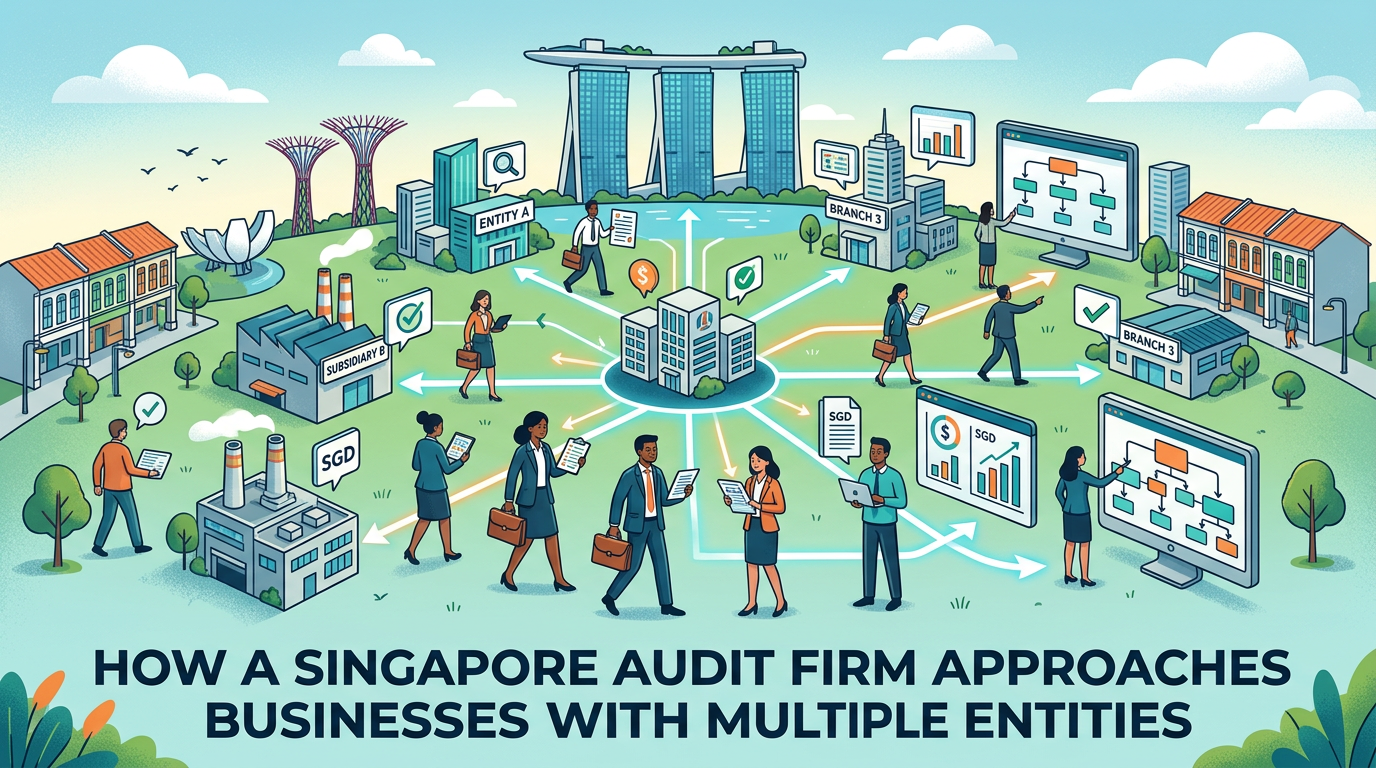
Business growth often brings a more complex company structure. What began as one operating company may eventually include a holding company, several subsidiaries, and overseas operations. Different entities may handle sales, employ staff, own assets, or provide services to other companies within the same group.
Although these businesses may operate under one brand, their financial records do not automatically form a clear picture of the group. Each entity has its own transactions and balances, while relationships between entities create additional accounting considerations. Money moving between group companies can be especially difficult to follow when documentation and reporting practices are inconsistent.
A singapore audit firm approaching this structure needs to understand both the individual operations and how their financial information comes together. For management, understanding that approach can make preparation more effective and help explain why a group audit involves more than collecting separate sets of accounts.
Understanding the Structure Before Reviewing the Numbers
An important starting point is understanding how the business is organised. The auditor needs to establish which entities exist, what they do, and how they relate to one another. An ownership chart is useful, but it should be supported by information about the underlying arrangements and any changes during the reporting period.
Consider a business with a Singapore holding company, a local trading subsidiary, and an overseas manufacturing subsidiary. The trading company may generate customer revenue, while the manufacturing operation produces goods and the holding company provides financing. Understanding those roles helps explain why particular balances and transactions arise.
Management can support this work by maintaining an updated structure chart and explaining acquisitions, disposals, new entities, and changes in ownership. Shareholder agreements and other relevant documents may also be needed to understand arrangements that are not obvious from shareholding percentages alone.
A clear explanation at the beginning reduces the risk of important information emerging late. It also gives the auditor a better basis for asking focused questions about the business.
Clarifying Which Financial Statements Are Being Audited
Having several companies does not, by itself, settle every reporting or audit requirement. The applicable framework, relationships between entities, and relevant exemptions need to be considered. Separate financial statements for an individual company and consolidated financial statements for a group serve different purposes.
Consolidated financial statements present a parent and its subsidiaries as a single economic entity. Preparing them involves more than adding figures together because transactions within the group must be addressed and the appropriate accounting requirements applied.
Management should clarify the engagement scope with its singapore audit firm early. Does the appointment cover group financial statements, particular company financial statements, or both? Are separate reports required for different entities, and what information will be needed for each engagement?
This discussion helps align expectations. It also avoids assuming that work completed for one reporting purpose automatically satisfies another, especially where companies operate in different jurisdictions.
How a Singapore Audit Firm Identifies Areas Requiring Attention
A group audit is planned around the risks of material misstatement in the group financial statements. The auditor considers where significant errors could arise and designs work to respond to those risks. The same amount or type of work is not necessarily appropriate for every part of the business.
A high-volume trading operation, for example, may raise different questions from a holding company with few transactions but a substantial investment balance. Similarly, an entity that has recently changed its accounting system may present different challenges from one with stable processes.
A smaller entity can still contain an important risk. An unusual transaction or a balance involving significant judgement may require attention even where that entity contributes relatively little revenue.
Management should therefore be prepared to explain more than entity size. Changes in operations, staffing, systems, financing, and commercial arrangements can all help the auditor understand where closer examination may be needed.
Reviewing Intercompany Balances and Transactions
Transactions between related group companies are a common source of reporting difficulties. One entity may pay expenses on behalf of another, provide funding, charge management fees, or sell goods to another group member. Each transaction needs to be recorded appropriately in the relevant accounts.
Suppose Company A records S$120,000 receivable from Company B, but Company B records only S$105,000 payable to Company A. The difference needs to be investigated. Possible explanations include an unrecorded invoice, a payment recorded in different periods, or inconsistent treatment of a shared expense.
Management should reconcile these balances before submitting the consolidation package. A useful reconciliation identifies both sides of the transaction, explains differences, and records the corrections required. Simply adjusting one figure to make the totals agree can conceal the underlying problem.
Supporting agreements also matter. Where companies charge each other for services or provide loans, the records should explain the nature and terms of those arrangements. Clear documentation makes it easier to understand what a balance represents and why it exists.
Looking Beyond Matching Balances During Consolidation
Even when intercompany balances agree, the consolidation process requires further attention. Internal transactions must be treated appropriately so the consolidated financial statements reflect the group’s dealings as a single economic entity.
For example, imagine one subsidiary sells inventory to another at a profit, and some of that inventory remains within the group at the reporting date. The consolidation needs to address the profit included in the unsold inventory. Matching the seller’s receivable to the buyer’s payable does not resolve that separate issue.
Management should maintain a clear record of consolidation adjustments, including their purpose, calculation, and supporting information. A spreadsheet containing unexplained journals can be difficult to review, particularly when the person who prepared it is unavailable.
The auditor examines the consolidation process and relevant adjustments as part of the group audit. Management remains responsible for preparing the financial statements and supporting the accounting decisions reflected in them.
Managing Differences in Accounting Practices
Entities within a group may use different accounting systems, account codes, or reporting templates. Those differences can make it harder to bring information together, even when each finance team believes its own records are complete.
One subsidiary may classify delivery costs within its cost of sales, while another places similar expenditure under administrative expenses. A group reporting team needs a clear mapping process to understand the information it receives and apply the appropriate group presentation.
A common reporting package can make that work more manageable. It can specify the schedules required, explain account mappings, and identify the person responsible for answering questions. Instructions should be detailed enough to prevent avoidable inconsistency without creating unnecessary administrative work.
Management should also identify differences in accounting policies and determine the adjustments needed under the applicable reporting framework. Waiting until the final consolidation to investigate these differences can place pressure on both preparation and review.
Coordinating Overseas Entities and Component Auditors
Where a group includes overseas operations, the group audit may involve other auditors performing work on components. Coordination is important because local reporting schedules and requirements may differ from those of the group.
The group auditor needs appropriate involvement in the work performed for the group audit. Communication with component auditors includes relevant risks, planned work, findings, and matters that could affect the group financial statements.
For management, the practical implication is that an overseas subsidiary’s completed local audit may not be the end of the information-gathering process. Further work or explanations may be needed for the group engagement.
Early introductions and clear responsibilities can help. Each location should know who coordinates requests, which reporting package to use, and when information is due. Access restrictions or difficulties obtaining records should be raised promptly so their implications can be assessed.
Understanding Shared Systems and Finance Processes
Several legal entities may depend on one central finance team or accounting platform. That arrangement can improve consistency, but it also means a problem in a shared process may affect more than one company.
For example, if staff select the wrong company when entering supplier invoices, expenses and liabilities may be recorded in the wrong entity. If shared bank-access arrangements are unclear, management may struggle to establish who can initiate or approve payments for each company.
Management should be able to explain how transactions are assigned to the correct entity and how access rights are maintained. Written responsibilities, sensible system permissions, and documented reviews can make these processes easier to understand.
The audit approach takes relevant systems and controls into account when assessing financial reporting risks. This does not mean the financial statement audit provides a separate opinion on every operational process or technology control.
Preparing a Group Reporting Timetable
A group reporting deadline depends on several connected tasks. Entity accounts need to be prepared, internal balances reconciled, reporting packages reviewed, and consolidation adjustments completed. Delays at an early stage can affect everything that follows.
A practical timetable should work backwards from the required completion date. It should allow time for management review and responses to audit questions, rather than assuming that the first version of every schedule will be final.
Different entities may need different preparation periods. A company with inventory, complex contracts, or substantial manual records may need more lead time than one with limited activity. Management should consider these differences when assigning deadlines.
A central coordinator can monitor progress and identify dependencies. That person does not need to answer every technical question, but should know who owns each task and when unresolved matters require escalation.
Common Preparation Problems Management Can Address
Some group audit difficulties arise from uncertainty about who owns the records. A subsidiary assumes the parent has retained a loan agreement, while the parent expects the subsidiary to provide it. Similar gaps can arise over invoices, ownership documents, and explanations for older balances.
A shared document index can help establish where key information is stored and who maintains it. Access should remain appropriate to the sensitivity of the records, particularly where overseas teams or external parties are involved.
Another recurring problem is unexplained movement in accounts. Management may provide an updated trial balance without identifying what changed after the previous version. A clear version history and adjustment log make it easier to understand revisions and avoid working from outdated information.
These improvements are practical preparation measures. They do not eliminate audit questions, but they make the information behind management’s answers easier to locate and assess.
Keeping Management and Auditor Responsibilities Clear
Engaging a singapore audit firm does not transfer responsibility for financial reporting away from management. Management needs to prepare the accounts, maintain supporting records, make the necessary accounting assessments, and oversee the consolidation process.
The auditor’s role is to obtain sufficient appropriate audit evidence to support an opinion on the financial statements. Questions, proposed adjustments, and requests for further information form part of that independent examination.
Where management requires additional help with preparation, the scope of that support should be discussed separately. If assistance is sought from the audit firm, applicable independence requirements must also be considered.
Clear responsibilities help the engagement run more effectively. They reduce misunderstandings about who prepares a schedule, who approves an adjustment, and who must resolve an outstanding accounting question.
Discussing Group Audit Needs With Gekonnt
Gekonnt lists group audit and consolidation services among its offerings. Its service information describes areas including intercompany transactions, accounting policy alignment, coordination, and the review of consolidated financial information.
For a business approaching Gekonnt about a group engagement, a useful starting point is a current structure chart and a brief description of each entity. Management can also explain where the companies operate, who maintains their records, and whether other auditors are involved.
The discussion should cover the required reports, reporting timetable, access to information, and responsibilities on both sides. The precise scope should reflect the business’s circumstances and the applicable professional requirements.
Early communication gives both management and the audit team a clearer understanding of the work ahead. It also creates time to identify missing information before reporting deadlines become difficult to manage.
Bringing the Group’s Financial Picture Together
A business with multiple entities needs a clear view of how those entities connect financially. Separate records, internal transactions, shared processes, and consolidation adjustments all contribute to the final picture.
A singapore audit firm approaches that picture by understanding the structure, assessing relevant risks, and obtaining evidence to support its audit opinion. Management supports the process through accurate records, timely reconciliations, clear explanations, and coordinated reporting.
For growing businesses, the most useful preparation starts before the audit begins. Keeping the structure chart current, documenting internal arrangements, and assigning reporting responsibilities can make a complex engagement more manageable. Businesses planning a group audit can discuss their structure and reporting needs with Gekonnt to establish an appropriate scope and timetable.