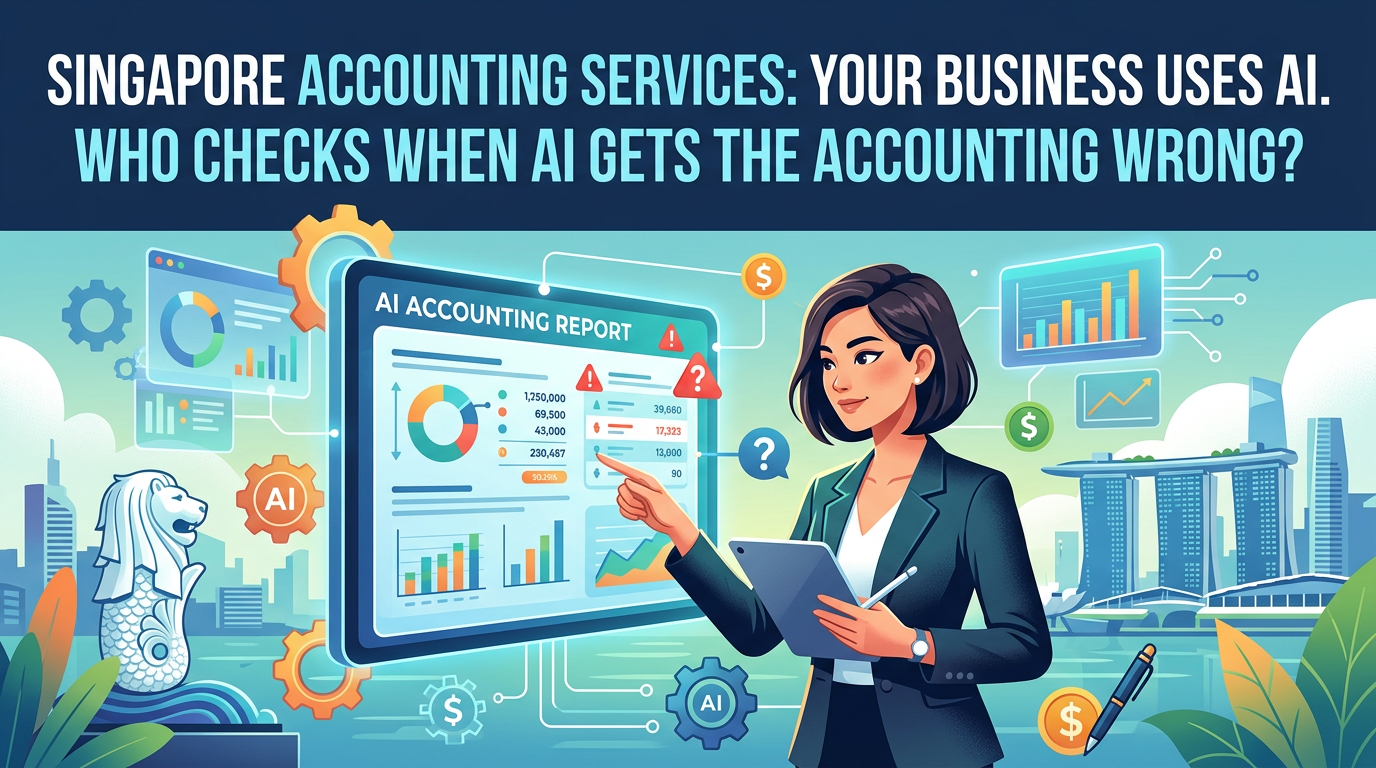
AI Is Already Moving Into the Finance Department
Artificial intelligence is no longer something Singapore businesses discuss only when talking about technology companies or future innovation. AI is increasingly appearing inside the everyday software businesses already use, including accounting platforms, expense management systems, invoice processing tools, customer relationship management systems and financial reporting applications. A finance employee who previously spent hours entering supplier invoices may now upload a document and allow software to extract the supplier name, invoice number, date, amount and tax information automatically. Bank transactions can be matched against accounting entries, expenses can be categorised and unusual transactions can be highlighted for review. For a growing SME, the attraction is obvious. Less manual work can mean faster processing, lower administrative pressure and more time for employees to focus on higher-value activities. However, there is an important question that can easily disappear behind the excitement surrounding automation. If AI increasingly decides how financial information is processed, who is responsible for checking whether those decisions are correct? Businesses considering professional Singapore accounting services need to think about AI not simply as a productivity tool, but as another part of the financial process that requires appropriate human oversight.
Singapore Businesses Are Being Encouraged to Adopt AI
AI adoption is becoming increasingly relevant to Singapore’s wider productivity strategy. Businesses are being encouraged to use technology to improve efficiency, redesign work and increase employee productivity rather than treating AI merely as an experimental tool. Singapore’s accountancy profession is changing alongside this trend. In 2026, ACRA refreshed the Skills Framework for Accountancy to incorporate competencies relating to artificial intelligence, digital technologies and sustainability, reflecting how the skills required of accounting professionals are evolving. The direction is therefore not towards accountants ignoring AI. It is towards accounting professionals understanding how to use technology effectively while continuing to apply professional knowledge and judgement. For businesses, this distinction matters. The question should not be whether AI belongs in accounting. The more useful question is how AI should be incorporated without allowing speed and convenience to weaken the reliability of financial information.
The First AI Accounting Experience Can Feel Almost Magical
Anyone who has manually processed large numbers of invoices can understand why AI-powered accounting tools are attractive. Imagine receiving 200 supplier invoices every month. Traditionally, someone might need to open each invoice, identify the supplier, enter the invoice date, type the amount, select an expense account and attach the supporting document. It is repetitive work, and repetitive work creates opportunities for human mistakes. Now imagine software reading the document automatically and suggesting most of those details within seconds. The employee only needs to review the information before accepting it. What previously required several minutes may take less than one minute. Multiply that saving across hundreds or thousands of transactions and the productivity benefit can become substantial. AI can therefore solve genuine operational problems in finance departments, especially where employees spend large amounts of time moving information between documents and systems.
Automation Does Not Mean the Information Is Automatically Correct
The danger begins when convenience gradually becomes unquestioned trust. If software successfully processes 99 invoices, an employee may naturally become less cautious when reviewing invoice number 100. Eventually, the review may become little more than clicking “approve.” The software has been correct so often that employees stop considering whether it could be wrong. This is a human behaviour problem as much as a technology problem. Reliable automation can actually encourage weaker review because people become accustomed to accepting its recommendations. Businesses should therefore distinguish between automated processing and verified information. AI may suggest what a transaction means, but the company still needs an appropriate process for determining whether that suggestion is reasonable.
One AI Error Can Become Hundreds of Identical Errors
Manual mistakes are often inconsistent. One employee might accidentally classify a S$2,000 software subscription as office expenses and then classify the next one correctly. Automated errors can behave differently. If a rule, model or configuration repeatedly interprets a particular transaction incorrectly, the same mistake may be reproduced across hundreds of transactions. A small classification problem can therefore become a systematic problem. Imagine an accounting tool consistently treating a particular category of expenditure incorrectly throughout the year. Every monthly report may appear internally consistent because the same treatment is applied every time, yet the underlying accounting could still require correction. Consistency is useful, but consistently wrong information is not reliable information.
AI Can Read an Invoice Without Understanding the Business Story Behind It
An invoice contains data, but accounting often requires context. Suppose an invoice says the company paid S$60,000 for “equipment and installation.” Software may recognise the supplier, amount and invoice date perfectly. But what exactly was purchased? Is the entire amount an immediate operating expense? Does part of it relate to an asset? Does the payment include maintenance covering a future period? Is the equipment already available for use? Are there multiple components requiring different treatment? These questions may require knowledge of the transaction beyond what appears on the invoice. AI can help extract information from documents, but accounting professionals may still need to understand what actually happened economically before determining the appropriate treatment.
The Same Supplier Can Sell Different Things
Automatic categorisation can work extremely well when transactions are predictable. If a company pays the same telecommunications provider every month for an ordinary phone bill, the appropriate category may be straightforward. But supplier identity alone cannot always determine accounting treatment. A technology vendor could sell a monthly software subscription in January, consulting services in March and computer equipment in June. If the accounting system automatically classifies everything from that supplier as “software expense,” the June transaction may require further consideration. The lesson is not that automatic categorisation is unreliable. It is that rules based on historical patterns need exceptions, and employees need to recognise when a transaction falls outside the normal pattern.
Bank Feeds Show What Happened to Cash, Not Necessarily Why
Automated bank feeds are another major improvement in modern accounting. Transactions can flow directly from bank accounts into accounting software, reducing manual entry and allowing reconciliations to be performed more efficiently. However, the bank transaction itself provides only part of the accounting information. A S$20,000 payment tells the system that money left the bank. It does not necessarily explain whether the payment was for inventory, equipment, a supplier deposit, repayment of a loan, reimbursement of an employee or something else. AI may make a highly probable suggestion based on historical patterns, but unusual transactions still require investigation. Businesses should therefore avoid assuming that because every bank transaction has been automatically matched, the underlying accounts must be correct.
A Green Tick Is Not an Accounting Opinion
Modern software interfaces are designed to make complex processes easy to understand. A green tick might indicate that a bank transaction has been matched, an invoice processed or a reconciliation completed. These visual signals are useful, but they can create false confidence when users interpret them too broadly. A reconciled bank account does not prove that revenue has been recognised appropriately, all liabilities have been recorded or every expense has been classified correctly. It usually means that the relevant reconciliation process has been completed according to the information available. Management should therefore understand what each automated status actually confirms rather than treating every green indicator as evidence that the entire accounting record is correct.
AI Does Not Know What Management Forgot to Tell It
A system can process the information it receives. It cannot always identify transactions that were never entered. Suppose the company received professional services worth S$30,000 before year-end, but the supplier has not yet issued an invoice and nobody informed finance that the work was completed. There may be no document for AI to process. Similarly, if an employee paid a business expense personally but never submitted a claim, the accounting system may know nothing about it. Completeness remains a fundamental challenge. Better automation can reduce errors in processing existing information, but it cannot automatically guarantee that all relevant financial information entered the system in the first place.
Artificial Intelligence Cannot Replace Internal Communication
This is why good accounting still depends on communication between finance and other departments. Operations may know that a project has been completed. Sales may know that a customer contract was modified. Procurement may know that equipment was delivered. Management may know that a legal dispute exists. Finance needs relevant information from across the business to prepare appropriate accounts. AI may help analyse or process that information, but it cannot automatically discover every conversation, commercial arrangement or management decision. Companies implementing advanced accounting technology should therefore avoid neglecting basic communication processes. Better software does not remove the need for departments to tell finance what is actually happening.
Human Review Should Focus on Risk, Not Repeating the Machine’s Work
Human oversight does not mean an employee must manually redo everything the AI has already completed. That would defeat much of the purpose of automation. Instead, businesses should design review processes around risk. Ordinary recurring transactions with predictable characteristics may require less attention, while unusual, large or complex transactions receive greater scrutiny. For example, a recurring S$100 monthly software subscription may not require the same level of review as a S$500,000 equipment purchase. AI can help identify exceptions and direct employees towards transactions that deserve attention. The objective is to use human judgement where it creates the most value rather than forcing employees to manually duplicate automated work.
Someone Still Needs to Own the Accounting Decision
One of the most important questions businesses should ask when implementing AI is who remains responsible for the final result. If software suggests an accounting treatment and an employee approves it, responsibility does not simply transfer to the software provider. Management remains responsible for the company’s financial records and financial reporting obligations. Employees using AI therefore need appropriate knowledge to understand what they are approving. A process where nobody understands the accounting because “the system does it automatically” creates significant dependence on technology without sufficient oversight. Automation should support accountability, not make accountability disappear.
The Employee Reviewing AI Needs Enough Knowledge to Challenge It
This creates an interesting skills challenge. If AI performs more routine accounting work, employees may spend less time learning through repetitive processing. Yet those same employees may eventually be expected to review the AI’s recommendations. How can someone identify an incorrect classification if they do not understand the underlying accounting? Businesses need to ensure that automation does not remove opportunities for employees to develop fundamental financial knowledge. The future finance professional may perform less manual entry, but that makes judgement, analytical ability and understanding of controls even more important. ACRA’s refreshed Skills Framework for Accountancy reflects this broader shift towards technology-enabled roles rather than technology replacing professional capabilities altogether.
AI Can Make Month-End Faster, but Faster Is Not Always Better
One attractive benefit of automation is the potential to shorten the monthly closing process. Transactions can be processed throughout the month, reconciliations can happen more continuously and reports can be generated faster. Management may receive financial information earlier, which can improve decision-making. However, speed becomes dangerous if it encourages employees to skip review. Closing the accounts in three days is not necessarily better than closing in seven days if significant errors remain. The objective should be to remove unnecessary administrative delays while maintaining appropriate checks. Businesses should measure the quality of the close as well as the number of days required to complete it.
AI-Generated Reports Can Look More Certain Than the Data Deserves
Generative AI can turn financial information into polished summaries. Management might receive a paragraph explaining that revenue increased, margins improved and operating expenses remained stable. This can make financial reporting easier to consume, particularly for business owners who do not want to analyse every line of a spreadsheet. But the quality of the explanation still depends on the underlying data and the instructions given to the system. If accounting records are incomplete or incorrectly classified, an AI-generated analysis may confidently explain numbers that should not have been trusted in the first place. A beautifully written financial summary cannot repair unreliable accounting data.
The Wrong Number Can Produce a Very Convincing Explanation
This is particularly important because generative AI is designed to produce coherent responses. Suppose an expense category suddenly increases by 40% because several transactions were misclassified. An AI tool analysing the accounts might generate a plausible explanation for the increase based on the data it sees. The explanation could sound intelligent even though the underlying premise is wrong. Management should therefore avoid confusing fluency with accuracy. Financial analysis should begin with reliable accounting records, followed by appropriate interpretation. AI can accelerate interpretation, but it should not become a substitute for verifying the information being interpreted.
AI Can Help Find Unusual Transactions Humans Might Miss
The story is not entirely about risk. AI can strengthen financial controls when implemented appropriately. Humans are not particularly good at reviewing thousands of repetitive transactions and maintaining equal attention throughout the process. Technology can identify patterns and flag exceptions that might otherwise go unnoticed. Duplicate invoices, unusual transaction amounts, unexpected supplier activity or inconsistent expense patterns may be easier to identify with automated tools. This allows finance employees to focus on investigation rather than scanning endless lists manually. In this sense, AI can improve control by directing human attention towards areas where judgement is most useful.
Fraud Detection Can Improve, but AI Is Not a Guarantee Against Fraud
Businesses may also use technology to identify suspicious patterns, but management should be cautious about assuming AI can eliminate fraud. Fraud often involves people deliberately attempting to bypass controls, conceal information or imitate legitimate activity. An automated system may identify unusual behaviour, but sophisticated fraud may be designed specifically to appear normal. Strong controls still require appropriate approval procedures, segregation of duties, access management and independent verification of sensitive changes. AI can become another layer of defence, but it should not become the only layer.
Supplier Bank Detail Changes Deserve Human Attention
Consider a supplier emailing the company to say that its bank account has changed. An automated workflow might update supplier information and prepare future payments using the new details. That is efficient when the instruction is legitimate. It is dangerous if the email came from a compromised account or an impersonator. Sensitive changes such as bank details should therefore receive independent verification according to the company’s control procedures. This is a useful example of where making the process slightly slower can actually protect the business. Automation should accelerate routine activity, but unusual changes involving money deserve appropriate scepticism.
Access Controls Become More Important as Systems Become Smarter
As accounting platforms become more integrated, businesses should review who can access what. Can one employee create a supplier, change bank details and approve a payment? Can former employees still access the accounting platform? Does every user have administrator permissions because it was easier during implementation? AI does not solve weak access controls. In some cases, increased automation can make excessive access more dangerous because actions happen faster. Businesses should therefore periodically review user permissions and ensure access reflects employees’ actual responsibilities.
Do Not Let AI Create a Black Box Inside Your Finance Function
A dangerous situation occurs when management knows that the system produces numbers but nobody understands how. Employees say, “The software calculated it,” and the conversation ends. This creates a black box where important financial outcomes cannot be explained. Businesses should maintain enough documentation and knowledge to understand significant automated processes. What rules are being used? Which transactions are processed automatically? What requires approval? How are exceptions handled? Who can change the configuration? The company does not need every director to understand technical algorithms, but it should understand how important financial information moves through its systems.
Changing the Automation Rule Can Change Hundreds of Transactions
Traditional manual processes often create transaction-level risk. Automated systems can introduce configuration risk. Suppose a rule tells the accounting platform to classify every payment containing a certain description into a specific account. If someone changes that rule incorrectly, hundreds of future transactions may be affected. Businesses therefore need controls not only over transactions but also over changes to the systems processing those transactions. Significant configuration changes should be authorised, tested where appropriate and monitored after implementation. The more automation the company uses, the more important system governance becomes.
Historical Data Can Teach AI Historical Mistakes
AI systems and automated recommendations often learn from previous patterns. That creates another subtle risk. What if the historical accounting treatment was wrong? A system may observe that the company has always classified a particular transaction in a certain way and recommend continuing the same approach. From the system’s perspective, it has learned successfully. From an accounting perspective, it may simply have automated an old mistake. Businesses should therefore review the quality of historical data when relying on pattern-based automation. Past consistency should not automatically be interpreted as evidence of correctness.
AI Makes Good Data More Valuable and Bad Data More Dangerous
This is one of the most important lessons for businesses adopting AI. Automation amplifies whatever information it receives. Clean supplier records, consistent account codes and well-maintained customer information allow systems to operate more effectively. Duplicate suppliers, inconsistent descriptions and poorly maintained records create confusion that automation may reproduce at greater speed. Companies therefore need to treat data quality as part of financial management. Before asking what AI can do with accounting information, management should ask whether the underlying information is reliable enough to automate.
Singapore’s Digital Finance Environment Is Becoming More Connected
The broader direction of Singapore’s business environment also makes data quality increasingly relevant. GST InvoiceNow requirements are being progressively expanded, moving businesses towards more structured electronic invoicing and digital transmission of invoice data. Businesses applying for voluntary GST registration from 1 April 2026 are already within the requirement, while existing GST-registered businesses are scheduled to be phased in progressively from April 2028 through April 2031. As financial systems become more connected, companies will benefit from having cleaner records and clearer processes. Automation becomes much easier when information is structured consistently from the beginning.
Professional Accounting Is Moving Towards Judgement and Analysis
If technology can perform more data entry, reconciliation and document processing, businesses may reasonably wonder what accountants will do in the future. The answer is increasingly likely to involve interpretation, judgement, controls and business advice. An accountant who spends less time typing invoices can spend more time examining why margins changed, identifying cash-flow pressure, reviewing unusual transactions or helping management understand financial performance. This is why businesses considering Singapore accounting services should not evaluate accounting support solely by asking how quickly transactions can be entered. The more useful question is whether the finance function helps produce reliable information that management can actually use.
The Accountant Should Understand the Technology Without Blindly Trusting It
Modern accounting professionals increasingly need to understand both finance and technology. They do not necessarily need to become software engineers, but they should understand how automation affects financial processes. If a company uses automated bank matching, invoice extraction or AI categorisation, the accounting team should understand the limitations of those tools and where review remains necessary. This combination of technology awareness and professional judgement is becoming increasingly valuable as businesses adopt more sophisticated systems.
Small Businesses Should Not Automate Everything Just Because They Can
A small Singapore company does not necessarily need an advanced AI solution for every financial process. If the business processes 20 supplier invoices a month, implementing a complicated automated workflow may create more administrative effort than it saves. Technology should solve a real business problem. Management should identify where employees spend excessive time, where errors occur frequently and where information is delayed. Automation can then be targeted at those areas. Digital transformation is not a competition to install the largest number of tools. A simple process that employees understand can be better than a sophisticated system nobody knows how to control.
Growing Businesses Have More to Gain From Good Automation
The economics change as transaction volumes increase. A business processing 2,000 invoices a month can save substantial employee time if data extraction and routine categorisation are automated. A company operating multiple entities may benefit from better integration and consolidated reporting. Businesses with large customer bases may use automation to improve receivables monitoring. The greater the transaction volume, the more repetitive work exists and the more valuable well-designed automation can become. However, larger volumes also mean systematic errors can have greater consequences, making appropriate review even more important.
AI Should Free Finance Employees to Ask Better Questions
The most valuable outcome of accounting automation may not be lower headcount. It may be better use of existing employees. Instead of spending Friday afternoon manually matching hundreds of transactions, finance staff could ask why a major customer’s outstanding balance has doubled. They could investigate why gross margin fell from 35% to 29%, identify a recurring unnecessary expense or prepare a cash-flow forecast for management. These activities help the business make decisions. If AI simply allows employees to process more transactions without creating time for analysis, the company may be capturing only part of the potential benefit.
Management Still Needs to Understand the Numbers
Business owners should also resist the temptation to delegate all financial understanding to AI. A dashboard can display profit, cash and receivables. An AI assistant can summarise performance. An accountant can prepare monthly reports. But management still needs enough financial understanding to ask sensible questions. Why did profit increase while cash decreased? Why are receivables growing faster than revenue? Why did one expense category suddenly double? Technology can make information easier to access, but management remains responsible for using that information to run the business.
Establish Clear Rules for What AI Can and Cannot Do
Businesses adopting AI in finance should define boundaries. Perhaps the system can automatically categorise routine transactions below a certain level while unusual transactions require review. Maybe invoice information can be extracted automatically, but payments still require authorised approval. AI might generate management commentary, but significant conclusions are reviewed before being distributed. The appropriate rules will vary according to company size, transaction complexity and risk. The important point is that automation should be intentional. Employees should know where AI is trusted, where human approval is required and what happens when the two disagree.
Review Exceptions Instead of Pretending They Do Not Exist
Every automated system will encounter transactions it cannot confidently process. These exceptions should not be viewed as failures. They are often exactly where human expertise creates value. An unusual contract, new supplier, large asset purchase or complex foreign-currency transaction may deserve additional attention. A strong process allows routine transactions to flow efficiently while clearly identifying exceptions for review. Problems arise when employees force unusual transactions through automated workflows simply because management wants everything processed quickly.
Test Whether Automation Is Actually Saving Time
Companies should periodically evaluate whether their technology investments are delivering the promised benefits. Did invoice-processing time decrease? Did month-end become faster? Are fewer corrections required? Has employee overtime fallen? Are management reports available earlier? If the company pays for several AI-enabled platforms but employees still maintain parallel Excel spreadsheets and manually check everything, the automation may not be working as intended. Technology should be evaluated according to measurable improvements rather than impressive feature lists.
Do Not Measure AI Success Only by Headcount Reduction
Reducing administrative cost can be a legitimate objective, but it should not be the only measure of success. AI can create value through faster reporting, fewer errors, better visibility, improved controls and greater capacity. A finance team that remains the same size but supports twice the transaction volume may have achieved significant productivity improvement. Likewise, employees who spend more time analysing financial information may create greater value even if payroll costs do not decrease. Businesses should consider the broader impact of automation rather than assuming success means replacing people.
The Best Finance Function May Be Human Plus Technology
The debate is often framed as accountants versus AI, but this may be the wrong comparison. Humans are good at understanding context, applying judgement, communicating with management and investigating unusual situations. Technology is good at processing large volumes of structured information quickly and consistently. Combining those strengths can create a better finance function than relying exclusively on either one. The objective should therefore be to determine which activities machines should perform and where human involvement remains valuable.
Conclusion: AI Can Do the Accounting Work Faster, but Someone Still Has to Care Whether It Is Right
There is little reason for businesses to reject useful accounting technology simply because mistakes are possible. Humans make mistakes too. Employees mistype invoice amounts, select incorrect accounts, forget documents and overlook unusual transactions. Properly implemented automation can reduce many of these problems while saving substantial time.
The mistake is assuming that automation removes the need for oversight.
An AI system can extract an invoice.
Someone still needs to know whether the invoice represents a legitimate business transaction.
AI can suggest an account code.
Someone still needs enough accounting knowledge to recognise when the suggestion is inappropriate.
AI can match a bank transaction.
Someone still needs to understand what the payment actually represents.
AI can produce a management summary.
Someone still needs to know whether the underlying numbers deserve to be trusted.
AI can identify unusual transactions.
Someone still needs to investigate them.
And AI can make the entire finance process much faster, but management still needs to decide whether faster information is also reliable information.
For Singapore businesses, the direction is increasingly clear. Accounting is becoming more digital, more automated and more integrated. The accountancy profession itself is adapting, with ACRA’s refreshed Skills Framework recognising AI and digital capabilities as increasingly important competencies. At the same time, developments such as the progressive GST InvoiceNow rollout are moving businesses towards more structured financial data and connected systems.
Businesses therefore should not ask whether they should choose between technology and professional accounting.
They should ask how the two can work together.
At Gekonnt, businesses looking for Singapore accounting services can obtain professional support for their accounting and financial reporting needs as finance processes become increasingly digital. The value of professional accounting is not simply entering information into software. It is helping ensure that financial information remains organised, appropriately reviewed and useful to management.
The finance department of the future may process far fewer invoices manually.
It may perform fewer repetitive reconciliations.
It may use AI to analyse thousands of transactions within seconds.
But one responsibility will remain.
Someone still needs to ask whether the numbers are right.