
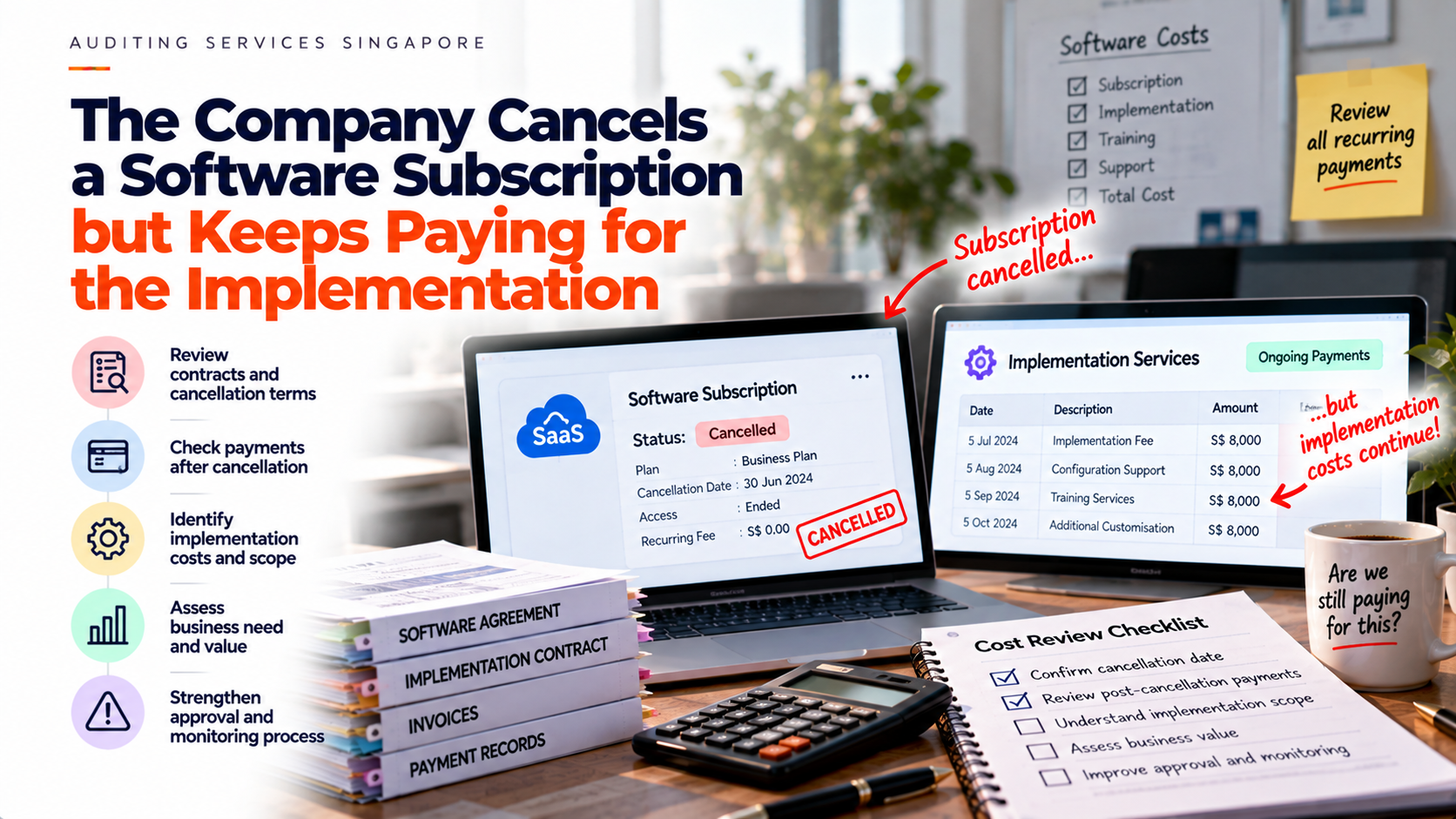
Management decides to cancel a software subscription after months of delays and disappointing results. The platform does not fit the business as expected, employees have returned to their previous processes, and the implementation project is being stopped.
The monthly subscription charge ends, but invoices from the implementation provider continue arriving. Finance also discovers that earlier payments remain recorded as prepayments or software development costs. The operational decision has been made, yet the financial position is far from settled.
Gekonnt PAC provides accounting, bookkeeping and financial reporting services. For businesses closing an unsuccessful software project, reliable records help distinguish outstanding obligations from avoidable spending and identify balances that need review. Cancelling access to a platform is one step. Understanding the remaining contracts, deliverables and accounting consequences completes the picture.
The Subscription and Implementation May Be Separate Arrangements
A software subscription and an implementation engagement often involve different agreements, even when they were presented together during the sales process. One contract may cover platform access, while another covers configuration, data migration, training or integration.
Ending the subscription does not automatically terminate the implementation agreement. The implementation provider may be a separate company, with its own notice requirements, milestones and payment terms.
Start by collecting the relevant contracts, statements of work, amendments and cancellation correspondence. Identify which agreement has actually ended and which obligations remain under review.
The company should also establish whether cancellation was acknowledged and its effective date. A request sent to a software account manager may not satisfy the process required under a separate implementation contract. Where the contractual position is unclear, appropriate legal advice may be needed before deciding what remains payable.
Establish What Each Continuing Invoice Represents
An invoice received after cancellation is not necessarily a charge for new work. It may relate to services already performed, an agreed instalment or a final settlement. Alternatively, it may arise because the provider has not stopped a recurring billing process.
Ask for a breakdown showing the service period, deliverable and contractual basis of each charge. Compare that information with the project records and the cancellation timeline.
A monthly payment arrangement can be particularly misleading. Six remaining instalments might represent an existing obligation for completed work, rather than six months of future services that can simply be cancelled.
The reverse is also possible: invoices may continue for support that is no longer being provided. Finance needs the underlying facts before approving payment or disputing the amount. Familiarity with the supplier and consistency with earlier invoices are not sufficient explanations.
Confirm What Work Has Actually Been Delivered
Management should obtain a clear status report from the internal project owner and implementation provider. Identify completed work, partially completed tasks, work not started and deliverables that remain disputed.
Useful evidence may include configuration records, migration reports, testing results, training attendance and acceptance correspondence. The review should explain what the company received, rather than rely solely on the percentage of the contract already invoiced.
A provider might have completed its contracted configuration work even though the business later decides not to use the platform. Alternatively, a milestone invoice may have been issued before the agreed deliverable was completed.
These situations can have different commercial and accounting consequences. An unsuccessful project does not mean no services were received, and an invoice does not prove that every promised service was delivered.
Prepare One Schedule of Payments and Commitments
Project costs may be spread across several suppliers and account codes. Subscription fees, consulting charges, employee expenses and integration work can appear in different reports, making the total position difficult to see.
Prepare a schedule showing the contracted amounts, approved changes, invoices received, payments made and remaining commitments. Link each item to the relevant agreement and deliverable.
Include deposits and credits, and distinguish amounts that are agreed from those under negotiation. The schedule should also identify where each amount appears in the ledger.
This creates a common basis for finance, management and the project team. Without it, one person may describe the project as fully paid while another is referring only to the software subscription, leaving the implementation balance outside the discussion.
Use a Simple Example to Separate the Questions
Consider a hypothetical company with a S$90,000 implementation agreement. It has paid S$60,000 when management decides to stop using the software. The provider requests the remaining S$30,000.
The company cannot determine the financial outcome from those figures alone. It first needs to establish whether the unpaid amount relates to completed services, future work, a contractual termination obligation or a disputed claim.
The S$60,000 already paid also requires review. Some may relate to services already received, some may remain an advance for undelivered work, and some may have been recorded as an asset under an earlier accounting assessment.
These are separate questions. The company’s liability to the provider does not automatically equal the carrying amount of a software asset or prepayment. Each balance needs its own explanation and supporting evidence.
Do Not Assume Implementation Spending Creates a Software Asset
The accounting treatment of implementation costs depends on the arrangement and the nature of the output. Paying a substantial amount does not, by itself, establish that the company controls an intangible asset.
The IFRS Interpretations Committee’s guidance on cloud software arrangements explains that configuration and customisation often do not create a separate asset controlled by the customer. In some circumstances, separately controlled code may qualify, subject to the relevant recognition criteria.
Where no intangible asset is recognised, service costs are generally expensed as the services are received. For certain services supplied by the software provider that are not distinct from access to the platform, the expense may instead be recognised over the access period. Advance payment does not settle that assessment.
Finance should therefore review the original accounting basis as well as the effect of cancellation. A balance labelled “software implementation” may contain several types of expenditure requiring different treatment.
Review Existing Asset and Prepayment Balances
Cancellation changes the facts supporting the project’s expected future benefits. Management should identify the amounts still carried in the accounts and assess whether those balances remain appropriate.
A prepayment for undelivered services needs a review of the remaining service or refund rights. A recognised intangible asset needs consideration of its continued use and recoverability under the applicable requirements.
The company should also distinguish a change in circumstances from an earlier accounting error. Costs correctly recognised under the original facts may require reassessment after cancellation. Costs that never qualified for the treatment applied need a different analysis.
Do not preserve a balance simply because recognising a charge would make the project’s financial outcome look worse. Equally, do not write off every amount without establishing whether usable deliverables, continuing rights or recoverable advances remain.
Assess Whether Anything Can Be Reused
Some work may remain useful after the original subscription ends. Process documentation, cleaned data or an integration component might support a replacement project.
Management should establish what the company owns or can access and whether the proposed reuse is realistic. A general intention to “use it later” is weaker than a documented plan identifying the deliverable, the intended application and any additional work required.
Operational usefulness does not automatically establish that expenditure qualifies as an accounting asset. The relevant recognition and measurement requirements still apply.
This distinction helps avoid transferring the entire failed project balance into a new project code without review. The replacement project should not become a convenient place to carry costs whose accounting basis remains unresolved.
Keep Refund Requests Separate From Confirmed Recovery
The company may seek repayment for incomplete work or negotiate a credit toward another service. Those discussions are commercially important, but a requested refund is not the same as an accepted and recoverable amount.
Document the basis of the request, the supplier’s response and any settlement terms. Where a credit is offered, consider whether the company can realistically use it and what restrictions apply.
Finance should avoid offsetting a disputed refund against an invoice merely to produce a lower net balance. The respective rights, obligations and accounting presentation need assessment.
Gekonnt’s accounting and bookkeeping services can support the organisation of these records. Management remains responsible for negotiating the commercial outcome and communicating the evidence needed to support the financial treatment.
Update the Cash Forecast Before Starting Again
Stopping the project may reduce future spending, but it can also create immediate payment requirements. Final invoices, agreed termination charges and transition work may fall due while the company begins paying for a replacement solution.
Prepare a cash forecast showing confirmed obligations, disputed amounts and possible refunds separately. A refund that has not been agreed should not be treated as dependable funding for the next implementation.
Management should also identify unavoidable overlap. Temporary access to the old platform or short-term support may be necessary to export records and maintain operations.
The forecast helps directors understand the actual savings from cancellation and the resources needed to move forward. A lower subscription bill may be only a small part of the overall cash effect.
Preserve Deliverables and Records Before Access Ends
Closing a software account can make project evidence and business records harder to retrieve. Before access expires, establish what data, configuration documents and transaction histories the company needs to retain.
Assign responsibility for exporting and checking those records. Confirm that the files can be opened and understood independently, rather than assuming that a completed download is sufficient.
The implementation provider may also hold documents or work products that have not been handed over. Identify what the company is entitled to receive and include those items in the closure discussions.
These steps support both continuity and financial review. Finance may need the evidence to explain payments and balances long after the operational team has moved to another system.
Give Project Closure a Named Owner
An unsuccessful implementation can leave responsibilities fragmented. IT focuses on ending access, procurement handles the supplier discussion, and finance waits for final invoices. Without coordination, each team may assume the project is already closed.
Name a person responsible for bringing the outstanding matters together. The closure record should identify remaining obligations, disputed items, accounting reviews, data handover and payment approvals.
Each item needs an owner and a next action. A project status of “cancelled” is not enough if payments continue and unresolved balances remain in the accounts.
The final review should confirm what has been settled and what remains open. Where an issue cannot yet be resolved, record its status clearly rather than removing it from the project report.
Review the Decisions That Led to the Outcome
Once the immediate position is understood, management should consider what can be improved before another implementation begins. The review should focus on evidence and decisions rather than assign blame based solely on the project’s failure.
Were the required functions tested before commitment? Were milestones specific enough to support acceptance? Did additional work require approval, and did finance understand the payment structure?
The answers can inform a more practical process for future projects. Clear deliverables, staged decisions and an early accounting review can help management understand both the operational progress and financial exposure.
The costs already incurred should also be visible when assessing the replacement proposal. They do not justify continuing with unsuitable software, but they form part of the company’s current financial position and available resources.
Close the Financial Position as Carefully as the Subscription
Cancelling software access can be a necessary business decision. It becomes more effective when the company also establishes what remains payable, what has been delivered and which recorded balances still have support.
A clear closure process separates contracts, reconciles payments and reviews accounting treatment. It also preserves the records needed to negotiate with suppliers and plan the next step.
Gekonnt PAC provides accounting, bookkeeping and financial reporting services for businesses reviewing their financial records. Companies closing software projects can discuss the supporting schedules and accounting assessments needed to explain the remaining position.
The practical starting point is a single list of agreements, invoices and ledger balances connected to the project. Trace each amount to its underlying purpose and assign the outstanding actions. That gives management a clearer basis for settling the old project before committing further resources to the next one.