Everything Looks Fine Until the Wrong Person Is Missing
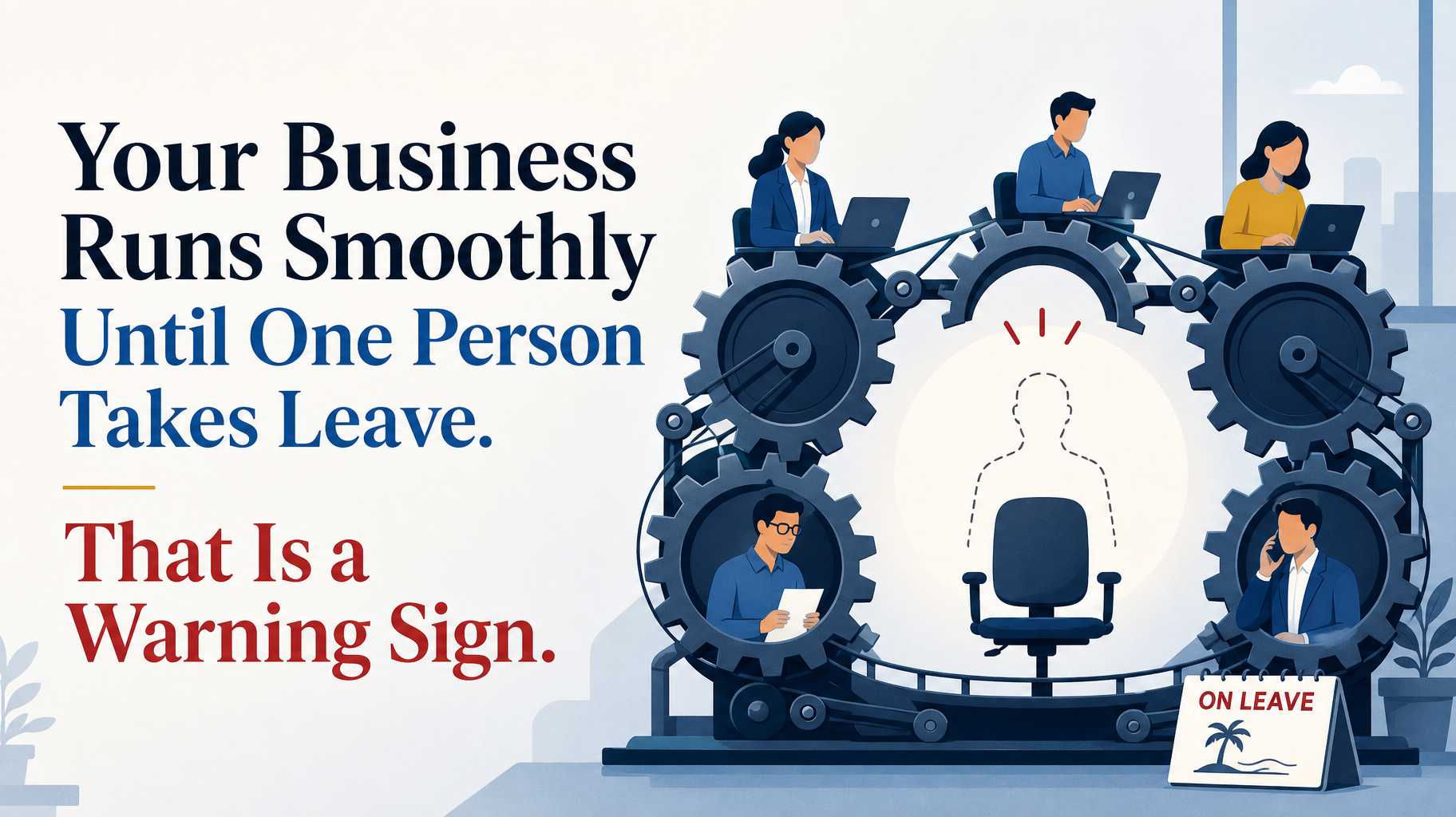
Most businesses do not discover key-person dependency during a strategy meeting. They discover it on a Monday morning when someone sends a message saying they are on medical leave, taking annual leave or dealing with a family emergency. Suddenly, payroll cannot be processed because only one employee knows the final steps. A supplier payment is delayed because only one person has access to the relevant approval process. A customer asks about an unusual contract and nobody else understands the history. Management tries to locate a spreadsheet, password or procedure and discovers that the missing employee normally handles everything from memory. The company was operating smoothly last week, so management assumed the process was strong. In reality, the process may have been relying heavily on one person who quietly kept everything together. A business that runs well only when specific individuals are present is not necessarily well organised. Sometimes it is simply fortunate that those individuals have not been unavailable at the wrong moment.
Key-Person Risk Does Not Mean the Employee Is Doing Something Wrong
When management hears the phrase “key-person risk,” it can sound like criticism of the employee involved. In many cases, the opposite is true. The employee may be highly capable, reliable and trusted precisely because they have spent years learning how the business works. They know which supplier responds fastest, which customer requires special billing, which bank process needs additional approval and which spreadsheet contains the real month-end numbers. The problem is not that the employee has too much knowledge. The problem is that the organisation has not captured enough of that knowledge outside the individual. Businesses should value experienced employees while also ensuring that essential operations do not depend entirely on one person’s memory, inbox or login credentials.
The Employee Who “Knows Everything” Often Became That Way Gradually
Key-person dependency usually develops slowly. A company starts with five employees, so one person handles finance, payroll and administration. The business grows to ten employees, then twenty, but the same person continues handling the same responsibilities because they are good at the work. New tasks are added because management trusts them. A bank account is opened, so they manage it. Payroll becomes more complicated, so they handle that too. A new reporting requirement appears, and they learn it because nobody else has time. After several years, the employee has become the only person who understands several critical processes. Nobody planned this concentration. It simply accumulated one responsibility at a time.
A Smooth Process Can Actually Be a Person Performing Invisible Manual Work
Management may believe a process is efficient because problems rarely occur. Payroll is always completed. Supplier payments go out. Customers receive invoices. Monthly accounts are prepared. But perhaps one employee spends several hours every week manually checking information, fixing errors and remembering exceptions that the system itself does not handle well. The process appears reliable because the employee is compensating for its weaknesses. When that person takes leave, the weaknesses become visible. This is why companies should distinguish between a strong process and a strong employee protecting a weak process.
Annual Leave Is One of the Cheapest Stress Tests a Business Can Have
Companies often spend money on business continuity planning, cybersecurity testing and disaster recovery, but ordinary annual leave can provide an extremely useful test of operational resilience. If a finance employee takes one week of leave, can someone else process routine payments? If the operations manager is away, can another employee respond to customer issues? If the company secretary is unavailable, does management know where corporate records are stored? A holiday does not need to create a crisis. It can reveal where procedures, access rights and responsibilities are too concentrated. Businesses should pay attention to what slows down when people are away rather than simply waiting for them to return and resuming normal operations.
“We Will Wait Until She Comes Back” Is a Red Flag When the Task Is Important
Sometimes waiting is perfectly reasonable. An employee may be working on a non-urgent project that can resume after their leave. The warning sign appears when essential work is repeatedly postponed because nobody else can perform it. A supplier payment waits three days. A customer quotation cannot be approved. Payroll questions remain unanswered. Management delays a report because the responsible employee is away. If business-critical tasks routinely stop when one person is absent, the company should ask whether sufficient backup exists. The goal is not for every employee to perform every job. It is to ensure essential functions have enough continuity to keep operating.
Payroll Is One of the Clearest Examples
Payroll can expose key-person dependency very quickly because employees expect to be paid correctly and on time regardless of who is on leave. In a small company, one finance or HR employee may understand the payroll system, overtime adjustments, unpaid leave, allowances, CPF-related information and final approval workflow. If that person suddenly becomes unavailable near payroll day, management may discover that nobody else has access or confidence to complete the process. A basic backup procedure can significantly reduce this risk. Another authorised employee does not need to become a payroll expert, but they should know enough to complete essential steps or coordinate with an external provider when necessary.
Supplier Payments Can Depend on One Person Too Easily
Another common situation involves supplier payments. One finance employee prepares the payment file, understands which invoices are urgent and knows which director normally approves them. If the employee is unavailable, accounts payable may slow dramatically. Suppliers then call operations, operations asks management and management eventually waits for the finance employee to return. The business may have enough money in the bank and perfectly valid invoices, yet payment cannot move because process knowledge is concentrated in one individual. Clear documentation and backup access can prevent a simple absence from damaging supplier relationships.
Banking Access Needs Particularly Careful Backup
Financial access should never be handled casually. A company should not solve key-person risk by giving everyone administrator access to its bank accounts. That would create a different and potentially more serious control problem. Instead, businesses should design appropriate authorised backup arrangements. Who can prepare payments? Who can approve them? Who can handle urgent transactions if the usual preparer is away? Are there dual-approval requirements? Are access rights reviewed periodically? Business continuity and internal control need to work together. The solution to dependency should not be uncontrolled access.
One Employee Should Not Be the Only Person Who Understands Customer Billing
Customer invoicing can look simple until unusual arrangements appear. Perhaps one major customer requires a special invoice format, another needs purchase order references and another has different billing milestones. The finance employee who normally handles these arrangements remembers all the details. When they are absent, another employee issues the invoice incorrectly and payment is delayed. The problem is not just administrative inconvenience. Poor billing continuity can affect cash flow. Important customer requirements should therefore be documented somewhere more reliable than one employee’s memory.
Long-Standing Customers Often Come With Long-Standing Exceptions
Businesses naturally develop special arrangements over time. One customer pays on different terms because of an agreement from five years ago. Another receives a specific discount. A third requires supporting documents before accepting invoices. These exceptions often live in the knowledge of the employee who manages the account. If that person is unavailable, colleagues may treat the customer according to the standard process and create confusion. Customer-specific information with financial or operational importance should be maintained in a shared system so the company can continue servicing the account consistently.
Supplier Relationships Can Have the Same Problem
A long-serving procurement or operations employee may know which supplier can deliver urgently, which contact answers after hours and which vendor requires a certain order format. This knowledge can be extremely valuable, but it becomes risky when nobody else knows where to find it. A company should not try to document every informal relationship, but basic supplier information, contractual terms and escalation contacts should remain accessible to the organisation. The business should benefit from the employee’s expertise without making the employee the only pathway to the supplier.
The Problem Becomes More Serious When the Employee Resigns Instead of Taking Leave
Annual leave ends. Resignation does not. A company that struggles during one week of employee absence should consider what would happen if the person handed in a resignation letter tomorrow. Would one month of notice be enough to transfer years of knowledge? Could management even identify everything that needs to be handed over? If the answer is no, the business already has a continuity problem. The best time to reduce dependency is while the employee is still happily working, not during the final two weeks of their notice period.
Handover Documents Created During Resignation Are Usually Too Late
When an employee resigns, management often asks them to prepare a detailed handover document. This is useful, but it has limitations. The employee may have accumulated hundreds of small pieces of knowledge over many years. Some are so routine that they do not realise anybody else would need them explained. The employee also has normal work to finish and may not remember every exceptional situation. A company can therefore end up with a 20-page handover document that still omits critical knowledge. Strong continuity comes from documenting processes during normal operations rather than trying to reconstruct everything at departure.
SOPs Help, but Only if They Match Reality
A standard operating procedure can reduce key-person dependency, but only if employees actually use it and it reflects the current process. Some companies have beautiful SOPs created several years ago that nobody has updated since. The finance team changed software, approval limits changed and several manual workarounds were introduced, yet the SOP still describes the old process. When the usual employee is absent, the backup follows the document and immediately discovers it is wrong. Procedures need to be practical, current and tested. A shorter document that accurately explains what employees really do is more useful than a detailed manual that belongs to another version of the business.
Screenshots Can Make Procedures Much Easier to Follow
For repetitive system-based tasks, simple visual instructions can be extremely useful. A backup employee may not need deep expertise if the procedure clearly shows where to access the system, which reports to generate, what checks to perform and who provides final approval. Screenshots, checklists and examples can make routine procedures easier to follow under pressure. The purpose is not to eliminate judgement. It is to prevent essential knowledge from disappearing into memory.
A Checklist Can Be More Valuable Than a 50-Page Manual
Many critical processes happen monthly, quarterly or annually. Because they are not performed every day, employees rely heavily on memory. A month-end close checklist, payroll checklist or annual filing calendar can reduce that dependency. The list might show what needs to happen, who owns each step, when it is due and what evidence confirms completion. If the usual employee is absent, someone else can at least understand the sequence. Checklists are particularly useful for tasks where forgetting one small step can create a larger downstream problem.
Cross-Training Does Not Mean Everyone Needs to Become an Expert
Business owners sometimes resist cross-training because they imagine every employee will need to learn every function. That would be inefficient. Cross-training should focus on critical tasks and emergency continuity. The backup finance employee may not need to understand every tax issue, but they should know how to process routine payments and locate important documents. The backup operations employee may not negotiate complex supplier contracts, but they should know how to contact the relevant vendors and manage ordinary orders. The objective is resilience, not duplication of every skill.
Two People Knowing a Critical Process Is Already Much Better Than One
Small businesses may not have enough employees to create elaborate backup structures. Even so, simply ensuring that a second person understands important tasks can materially reduce risk. The backup person can occasionally perform the process while the primary employee reviews it. This keeps knowledge current and reveals whether the documented procedure actually works. A backup who has never performed the task is less useful than someone who has completed it successfully at least occasionally.
Job Rotation Can Reveal Hidden Weaknesses
Occasional job rotation can be helpful in some functions because it forces processes to become understandable to more than one employee. When a different person performs a routine task, they often identify unclear steps, missing documentation or unnecessary complexity that the usual employee simply learned to work around. This can improve both resilience and efficiency. Rotation does not need to be permanent. Even periodic exposure can strengthen the organisation’s understanding of its own processes.
Mandatory Leave Can Also Support Control
In certain financial roles, organisations sometimes use periods of mandatory leave as part of broader control and fraud-risk management because uninterrupted personal control over a process can hide problems. The objective should not be to treat every dedicated employee as suspicious. Rather, a process that can function independently of one person’s continuous presence is generally healthier. If someone can never take leave because “nobody else can do the job,” management should see that as an organisational issue, not a sign of admirable commitment.
The Employee Who Never Takes Leave May Be Protecting the Company or Protecting the Process
A long-serving employee who rarely takes leave may simply be extremely committed. But management should still understand why their absence would be difficult. Perhaps they genuinely hold unique expertise. Perhaps procedures are undocumented. Perhaps system access is concentrated. Or perhaps the employee has become the only person capable of reconciling certain records because the process itself has developed unusual workarounds. The correct response is not suspicion. It is curiosity. The business should understand what depends on that employee and why.
Passwords Are Not a Continuity Strategy
Another common weakness is credential dependency. The only person who knows the password for a service is away. Management tries to contact them during leave because an urgent issue appears. This creates both operational and security problems. Shared passwords are not the solution either. Companies should use proper account administration, password management and authorised access structures so important systems remain accessible without undermining security. Critical business access should belong to the organisation, not one employee’s memory.
Personal Email Accounts Create the Same Risk
If a supplier relationship, software account or important business correspondence is tied to an employee’s personal email, the company may lose visibility when that employee leaves. Business systems should generally be linked to corporate-controlled accounts where practical, with appropriate administrators and recovery methods. The organisation should not discover after a resignation that an essential service can only be reset through someone’s private Gmail account.
Finance Systems Need Backup Administrators
Modern accounting software often contains extensive financial information and controls. If only one employee is the administrator, the company can face difficulties when that person is unavailable. At the same time, giving unnecessary administrator rights to everyone creates security and control risks. Businesses should identify appropriate backup administrators and maintain current access information. Periodic access reviews can help ensure former employees are removed and backup arrangements remain functional.
Month-End Is a Good Place to Test Dependency
Month-end closing brings together reconciliations, journals, customer balances, supplier information and management reporting. If the close becomes impossible when one employee is absent, management has identified a significant concentration of knowledge. A good finance process should have enough documentation and backup capability that routine month-end tasks can continue, even if completion takes slightly longer. Businesses should not accept a complete shutdown simply because one employee took legitimate leave.
Year-End Can Be Even More Dangerous
Year-end often involves additional work such as financial statement preparation, audit schedules, tax information and corporate reporting. If only one employee knows how the previous year’s files were prepared, the company becomes highly dependent on them at exactly the time finance workloads increase. Maintaining organised year-end folders, recurring schedules and prior-year references can help the next employee understand what needs to be done. This is especially important in businesses where financial knowledge has historically lived with one long-serving accountant.
An External Accountant Can Reduce Some Dependency, but Not All of It
Outsourcing can improve continuity because a professional firm may have several people capable of supporting the client. However, the business still needs internal knowledge about transactions, approvals and commercial context. An external accountant can process information but may not know why a customer received an unusual discount or why a particular supplier arrangement exists unless the company explains it. Outsourcing should therefore complement internal documentation rather than become another excuse for management not to understand its own processes.
Professional Support Can Provide a Useful Backup Layer
For smaller businesses, maintaining specialist expertise internally for every function can be expensive. Professional advisers can provide an additional layer of continuity across accounting, tax, audit and corporate matters. Gekonnt supports Singapore businesses across professional financial and corporate services, which can help companies avoid relying entirely on one internal employee for areas requiring specialised knowledge. The goal should still be clear responsibility and organised information, but external support can make the organisation more resilient when staff change or workloads increase.
Management Should Know Which Roles Are Truly Critical
Not every employee creates the same continuity risk. Businesses should identify roles where sudden absence would materially affect operations, cash flow, regulatory obligations or customer service. Finance, payroll, IT administration, key sales accounts, operations and corporate administration are common examples, but every company is different. Once critical roles are identified, management can assess what knowledge, access and responsibilities are concentrated there.
Make a Simple “What If They Are Away Tomorrow?” List
A useful exercise is to take each critical employee and ask what would stop if they were unavailable tomorrow. Which systems do they control? Which deadlines do they manage? Which customers depend on them? Which approvals require them? Which spreadsheets only they understand? Which suppliers contact them directly? This exercise can reveal dependency far more clearly than a generic organisation chart. It also helps management prioritise which risks need attention first.
Not Every Dependency Needs to Be Eliminated
Some specialised knowledge will always sit with particular experts. A senior tax professional may understand complex tax issues that a junior employee does not. A technical engineer may have expertise nobody else possesses. Completely eliminating this concentration may be impossible or economically inefficient. The goal is to ensure the business can continue essential operations while specialised issues wait for the appropriate expert. Dependency becomes dangerous when ordinary day-to-day activity cannot proceed without one individual.
Backup Does Not Mean Someone Can Do the Job Equally Well
This is another important distinction. If the usual finance manager is away, the backup employee may take longer to complete the process or need external help. That is acceptable. Continuity does not require identical performance. The objective is to prevent complete operational paralysis. A backup capable of maintaining essential functions until the expert returns is already valuable.
Managers Should Encourage Leave Instead of Quietly Discouraging It
If employees believe taking leave creates problems for colleagues or makes them look less committed, they may avoid using their entitlement. This can hide key-person dependency because the critical employee is almost always present. Management should create enough backup that employees can take normal leave without feeling guilty. A business that cannot tolerate legitimate employee absence has an organisational weakness that should be addressed rather than shifted onto staff.
A Healthy Company Should Not Need to Call Employees During Every Holiday
Occasional emergencies happen, and some senior roles may require limited availability in exceptional situations. But if management repeatedly contacts the same employee during every holiday because nobody else knows what to do, the company has not created a real backup. Leave is not truly leave if the employee remains the remote operating system for the entire department. The objective should be to reduce unnecessary interruptions by transferring routine knowledge before the person leaves.
Customer Service Can Reveal Dependency Very Quickly
A customer should not receive a completely different experience simply because their usual contact is away. Shared notes, CRM records and documented commitments allow another employee to understand recent conversations and continue supporting the account. If every customer relationship belongs exclusively to one salesperson’s phone and memory, the company is vulnerable not only during leave but also during staff turnover. Customer knowledge should gradually become organisational knowledge.
The Same Applies to Sales Pipelines
A salesperson may understand which deals are likely to close, what pricing was discussed and who the decision-maker is. If all this information exists only inside their personal notes, management loses visibility when they are unavailable. A properly maintained CRM or shared sales process helps the business continue following up opportunities. The company should benefit from personal relationships while still owning the commercial information surrounding them.
One-Person Dependency Can Affect Cash Flow Directly
Many examples of key-person risk sound operational, but the financial consequences can be immediate. Invoices are delayed because nobody knows the billing milestone. Customer collections slow because the person who normally follows up is away. Supplier discounts are missed because nobody processes orders. Payroll errors create additional work. Management reports arrive late, so cash problems are identified later. Continuity is therefore not simply an HR concern. It can affect liquidity and profitability.
Delayed Invoicing Is One of the Most Expensive Hidden Consequences
If a business normally issues S$1 million of invoices each month and billing is delayed by one week because the responsible employee is away, the company may effectively delay the collection cycle for a significant amount of cash. Revenue may still be recognised eventually, but cash arrives later. Companies should therefore give billing continuity the same attention they give other important finance processes.
Delayed Reporting Can Affect Decisions Too
Management may need monthly financial information to monitor margins, spending and cash flow. If the report is delayed because one employee is away, business decisions are made with older information. A one-week delay may not always matter, but repeated dependence on one person can become increasingly risky as the company grows. Reporting processes should be organised enough that another employee or external provider can continue the routine work.
Leave Can Reveal That Nobody Understands the Spreadsheet
A particularly common SME problem appears when an employee sends a spreadsheet before going on leave. The file has 18 tabs, hidden formulas, external links and colour coding nobody understands. Management asks another employee to update it and immediately receives the answer, “I don’t know how.” The spreadsheet may have worked perfectly for years, but the organisation never actually owned the process. It relied on the creator. Important spreadsheets should have clear instructions, sensible structure and enough review that someone else understands the logic.
Complex Spreadsheets Are Not Automatically Bad
Excel can remain an excellent business tool. The problem is not the software. The risk appears when important calculations depend on undocumented formulas and only one employee knows how the workbook functions. A second reviewer should understand critical spreadsheets, particularly those used for financial reporting, pricing or operational planning. If nobody can explain the calculations without the creator present, management should consider whether the process needs simplification or stronger documentation.
Automation Can Reduce Dependency but Can Also Create New Dependency
Automating repetitive tasks can make businesses more resilient because less knowledge is required to process routine work manually. But automation creates its own risks if only one employee understands how the system works. A workflow may run perfectly for two years until it fails while the employee who built it is on leave. Nobody knows how to restart it. Businesses should therefore document important automation and ensure access is not limited to a single individual.
AI Does Not Eliminate Key-Person Risk Either
AI can help employees draft documents, analyse information and automate tasks, but the organisation still needs to understand the underlying process. If one employee becomes the “AI person” who builds every prompt, workflow and automation, the company can simply replace one form of dependency with another. Technology should distribute capability rather than concentrate it further.
The Best Processes Are Understandable by More Than Their Creator
This is a useful design principle. A process does not need to be simplistic, but another suitably trained employee should be able to understand how it works. Documentation should identify inputs, key decisions, approvals, outputs and exceptions. If understanding requires years of informal knowledge, the process may need redesign. Businesses grow more resilient when essential systems are transparent enough to survive normal staff movement.
Management Should Review Exceptions, Not Memorise Every Detail
Senior management cannot become the backup for every process. That simply shifts key-person dependency from employees to the owner. Instead, the organisation should create clear ownership, documented routine processes and defined escalation points. Managers then become involved when exceptions arise rather than performing every task themselves. This creates a more scalable organisation.
Founder Dependency Is the Same Problem at a Higher Level
Sometimes the employee who cannot take leave is the owner. Every customer quotation requires the founder. Every supplier negotiation requires the founder. Every payment approval requires the founder. The business runs smoothly as long as the founder is available. This is still key-person risk, even if the key person owns the company. As businesses grow, founders need to ask whether they are building an organisation or simply creating a larger system that depends on them personally.
The Holiday Test Applies to the Managing Director Too
Imagine the managing director disappears for three weeks with no phone access. Can the company still operate? Managers should be able to handle routine customer decisions, finance should be able to process ordinary payments and employees should know their authority limits. Strategic matters may wait, but normal operations should continue. If everything stops, the company may need stronger delegation and management structures.
Business Value Can Be Affected by Key-Person Dependency
A potential investor or buyer may look beyond profit and ask how dependent the company is on specific people. A business generating strong earnings but relying entirely on one founder for sales, supplier relationships and operations may appear riskier than a company with documented processes and a capable management team. Reducing key-person dependency therefore does more than improve daily resilience. It can potentially strengthen the quality and transferability of the business itself.
Growth Makes Dependency More Expensive
A five-person company relying heavily on one employee may survive because everyone works closely together. At fifty employees, the same dependency can affect much larger transaction volumes, payroll and customer relationships. The cost of disruption grows with the business. Companies should therefore strengthen continuity before growth makes weaknesses expensive.
Use Good Times to Build Backup
The easiest time to improve business continuity is when everything is working normally. Employees have time to document procedures, backups can practise and management can test processes without urgency. Waiting until someone suddenly becomes unavailable turns improvement into crisis management. A healthy business should invest in resilience before it needs it.
Start With the Five Tasks That Cannot Stop
Management does not need to document everything immediately. Start with the five tasks that would create the biggest problem if they stopped tomorrow. Perhaps payroll, supplier payments, customer invoicing, bank access and monthly reporting. Identify the primary person, backup person, required access and basic procedure for each. This simple exercise can materially reduce risk without becoming a massive corporate project.
Then Test the Backup Instead of Assuming It Works
A backup plan written on paper may fail when used. The secondary employee may discover they lack system access or the instructions are outdated. Periodic testing is therefore important. Let the backup complete the task occasionally while the primary person is available to help. The business gains confidence, and gaps are identified before an emergency.
Keep the Process Simple Enough to Maintain
Documentation can become outdated if maintaining it requires too much effort. Businesses should focus on practical information employees will actually update. A checklist, shared folder and short procedure may be more sustainable than a complex manual. The objective is not perfect documentation. It is reliable continuity.
Conclusion: If One Week of Leave Stops the Business, the Problem Is Bigger Than the Leave
The employee takes five days of annual leave.
Suddenly:
Payroll waits.
Supplier payments wait.
Customer invoices wait.
Management reports wait.
A customer question waits.
Nobody knows the password.
Nobody understands the spreadsheet.
Everyone says:
“She will be back Monday.”
And when Monday comes, the employee catches up on everything.
The business returns to normal.
Management feels relieved.
But nothing has actually been fixed.
The company has simply confirmed that one person is carrying more operational dependency than the organisation realised.
That does not make the employee a problem.
It may mean the employee is exceptionally valuable.
But value and dependency are not the same thing.
A strong business should capture enough of that person’s knowledge that essential work can continue when they are unavailable.
Document the critical processes.
Create appropriate backups.
Maintain corporate-controlled access.
Cross-train selected employees.
Keep customer and supplier information in shared systems.
Test payroll and payment continuity.
Make sure important spreadsheets can be understood by more than one person.
Use professional support where specialised expertise would otherwise sit with a single internal employee.
And allow employees to actually take leave without turning their holiday into remote technical support.
At Gekonnt, businesses can obtain professional support across accounting, financial reporting, audit and related corporate services, providing an additional layer of financial and administrative continuity as organisations grow and their processes become more complex.
The objective is not to make employees interchangeable.
Experienced people will always matter.
Relationships matter.
Judgement matters.
Specialised knowledge matters.
But the company should own its processes, records and access.
One employee should be important because of the value they create, not because the company cannot function without them.
So the next time someone important books two weeks of annual leave, do not immediately ask:
“Who is going to cover all their work?”
Ask something more useful:
“Which parts of the business should already be able to continue without them?”
If the answer is “almost none,” the leave request has revealed something management needed to know.
The employee is not the warning sign.
The fact that the business stops without them is.