
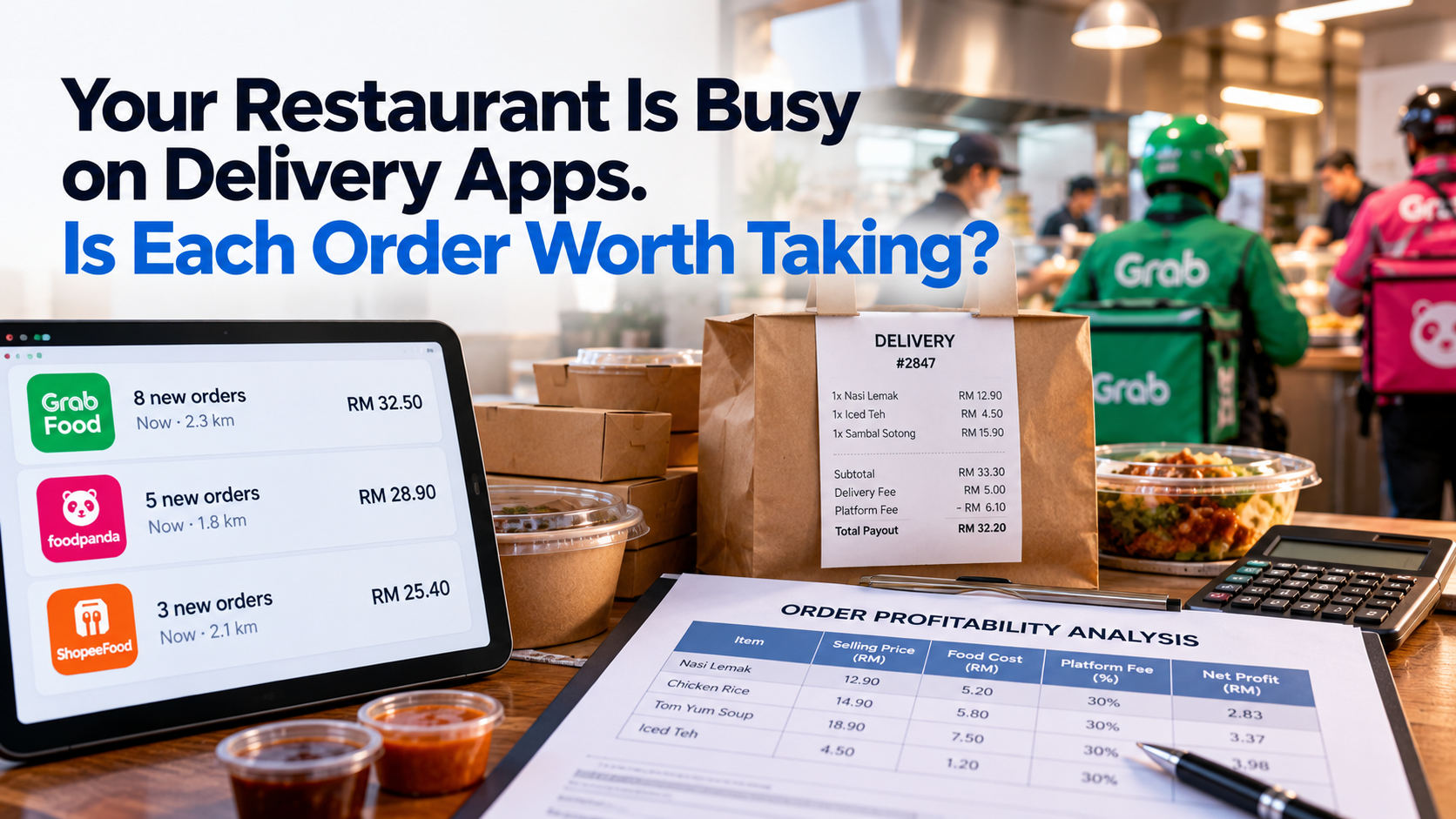
Your Restaurant Is Busy on Delivery Apps. Is Each Order Worth Taking?
The delivery tablet keeps sounding, takeaway bags cover the counter, and your kitchen team is working through another busy evening. The platform dashboard shows growing sales, which seems like good news. Yet the additional activity is not producing the improvement in cash or profit you expected.
For restaurant owners, delivery orders can bring valuable business beyond the dining room. They can also introduce costs and operational demands that are difficult to see in the sales total. Platform charges, promotions, packaging, refunds, and extra labour all affect what remains from each order.
Before pushing for more delivery sales, understand how those orders contribute to the restaurant. The useful question is how much they leave after the costs they generate, and whether serving them affects other business you could have handled.
Start With an Actual Order, Not the Monthly Sales Total
Choose a common delivery order and follow its financial journey. Begin with the amount attributable to the restaurant’s food and drinks, then identify the discounts and costs associated with preparing and fulfilling it.
Use the relevant platform agreement and settlement details. A customer’s total payment may include charges that do not belong to the restaurant, while the bank payout may contain deductions or adjustments relating to several orders.
For a meaningful comparison, use consistent figures and tax treatment throughout the calculation. If you are unsure how a settlement item should be classified, clarify it with your accountant before building it into the model. An inaccurate starting figure can make every later calculation misleading.
Calculate What the Order Leaves Behind
Consider a simplified hypothetical order with S$40 of menu value before a restaurant-funded discount. Assume that all figures use a consistent basis excluding GST and that the charges below come from the restaurant’s own records.
Menu value: S$40.00
Restaurant-funded discount: S$4.00
Amount after discount: S$36.00
Platform and payment charges: S$9.00
Ingredients: S$11.00
Packaging: S$2.00
Additional labour and other order-driven costs: S$3.00
Contribution remaining: S$11.00
The S$11 is the amount available to help cover costs not included in the calculation and, ultimately, profit. It is not the restaurant’s final profit from the order. These figures are illustrative, not typical platform rates or a recommended margin.
Build the same calculation using your actual arrangements. Check the basis on which percentage charges are calculated rather than assuming they apply to the amount after discounts. A small misunderstanding about the fee basis can become significant across many orders.
Identify Which Promotions the Restaurant Pays For
A promotion visible to the customer may be funded by the platform, the restaurant, or both. The advertised discount therefore does not automatically tell you how much your business has given up.
Review the campaign terms and actual settlement records together. Establish your contribution, any associated participation charges, and whether the offer can combine with other discounts. Make sure the person approving the campaign understands the full arrangement.
For example, a restaurant might approve a modest discount without realising that it can be combined with an existing bundle offer. Each individual promotion may seem affordable, while the combined result leaves much less contribution than expected. Assess the order as the customer can actually purchase it.
Use Current Recipe Costs and Realistic Portions
Ingredient costs should reflect what the kitchen uses, including reasonable preparation losses. An old recipe sheet may no longer represent current supplier prices, portion sizes, or ingredient substitutions.
Review the dishes that account for most delivery sales first. Check quantities with the kitchen team and compare expected usage with purchasing and stock information. Investigate significant differences rather than assuming the standard recipe is always followed.
A dish may appear attractive because its main ingredient is inexpensive, while sauces, garnishes, cooking oil, and preparation waste receive little attention. You do not need perfect measurement before making any decision, but the estimate should be credible enough to compare menu items and identify where further investigation is worthwhile.
Give Packaging Its Own Cost
Delivery packaging includes more than the main food container. Bags, lids, seals, sauce cups, cutlery, labels, and protective materials may all contribute to the cost of an order.
Consider how packaging changes with the basket. A single dish and a family bundle may require different numbers of containers, while drinks or delicate items may need additional protection. Using one average figure for every order can hide those differences.
However, choosing cheaper packaging without testing it can create other costs. Leaks, damaged presentation, and temperature problems may lead to refunds or remakes. Evaluate packaging by its cost and performance together, using actual customer feedback and incident records.
Treat Labour According to the Decision Being Made
The labour question changes depending on whether the kitchen has spare capacity. An additional order during a quiet period may be handled within an existing shift, while a sustained increase in delivery demand may require overtime or another employee.
For a short-term decision, identify the costs that change because the order is accepted. For a longer-term delivery strategy, include the staffing and supervision required to support the channel reliably. Do not assume that an existing payroll can absorb unlimited growth.
Avoid double-counting labour in your analysis. If additional staff time has already been included in an order calculation, make sure the same expenditure is not deducted again when assessing the delivery channel. Keep the assumptions clear enough for finance and operations to discuss together.
Ask What Happens During the Dinner Rush
An order that is worthwhile at 3 pm may have a different effect at 7 pm. During a quiet period, it can use available kitchen capacity. During a busy period, it may compete with dine-in orders for the same grill, fryer, preparation station, or packing area.
Identify the actual constraint. If the fryer is the limiting resource, increasing orders for fried items may create more disruption than adding dishes prepared elsewhere. The relevant issue is the capacity used and what other orders might be delayed or lost.
Compare the contribution from realistic alternatives where demand exists. Also consider quality, waiting times, and customer experience. A delivery sale can leave a positive amount on its own while reducing the restaurant’s overall result if it prevents more valuable work from being completed.
Compare Dishes as Well as Sales Channels
An overall delivery margin may conceal large differences between menu items. Some dishes travel well, require little packing time, and use ingredients shared with the dine-in menu. Others involve more preparation, fragile presentation, or costly packaging.
Review popular items individually and assess common baskets or bundles. Include the practical work involved, especially where a dish requires a separate preparation process or interrupts the kitchen’s normal sequence.
A bestselling item does not automatically deserve more promotion. If it consumes scarce capacity and leaves little contribution, management could consider changing the price, recipe, portion, packaging, or bundle structure. Test changes against customer expectations rather than assuming removal is the only option.
Include Refunds, Remakes, and Order Errors
Refunds and remakes can materially change the economics of delivery sales. Their causes may include missing items, incorrect preparation, packaging failures, or issues outside the restaurant’s control.
Track the reason, amount, and party bearing the cost. Distinguish between a platform-funded customer adjustment and a deduction charged to the restaurant. Where the restaurant disputes an amount, monitor the outcome rather than assuming recovery.
Use this information to improve the process. For example, repeated missing-drink refunds may justify a packing check rather than a general price increase. A useful cost review identifies where the problem originates and whether the business can reduce it.
Measure Campaigns by the Additional Contribution They Produce
A successful-looking promotion can increase order volume while leaving the restaurant financially worse off. Evaluate what changed compared with a reasonable expectation of trading without the campaign.
Suppose a campaign produces more orders, but many existing customers receive discounts on purchases they would probably have made anyway. The incremental benefit is smaller than the total campaign sales suggest.
Track campaign spending, restaurant-funded discounts, contribution, and the operational effect. If the objective is to attract repeat customers, review the evidence available over time. Treat future repeat purchases as an assumption to test, rather than a guaranteed justification for losing money on initial orders.
Check Whether Delivery Is Replacing Other Orders
Delivery can reach customers who would not otherwise visit, but some orders may shift from another channel. A regular customer might move from direct takeaway to an app because a promotion makes it cheaper or more convenient.
Where information is available, compare the contribution from the channels involved. Include the genuine costs of direct ordering, such as payment processing, administration, and any delivery arrangement. Direct orders are not automatically cost-free.
This comparison helps management decide where marketing effort is most useful. The aim is to understand whether the channel is adding business or changing how existing customers buy. Avoid assuming that every increase in app sales represents an equal increase in total restaurant demand.
Assess the Whole Channel Over a Suitable Period
Individual order calculations help explain the economics, but management also needs a broader view. Delivery may require channel-specific advertising, software, equipment, or dedicated staff that are not captured by an ordinary order model.
Prepare a periodic delivery contribution report and identify the additional costs of maintaining the channel. Then consider how the resulting contribution supports the restaurant’s shared overheads and overall profit.
An allocation of existing rent can be useful for some performance discussions, but it does not establish how much would be saved by stopping delivery. Conversely, covering immediate order costs alone does not prove the channel is sustainable over the long term. Use the measure that fits the decision.
Consider Cash Timing Alongside Profitability
Even profitable orders can create cash pressure when ingredients, wages, and packaging must be paid for before platform settlements arrive. Rapid growth can increase that funding requirement.
Review the settlement timetable and compare it with upcoming operating payments. Account for any unresolved deductions or held amounts that affect when cash is available. Use actual settlement patterns rather than relying only on reported sales.
For example, a busy campaign may require additional ingredient purchases before the related receipts reach the bank. Include that timing in the campaign plan. A promotion should be operationally deliverable and financially fundable, as well as attractive on an order-level calculation.
Make Targeted Changes and Monitor the Result
Once the review identifies the main issue, choose a specific response. Options might include revising selected prices, simplifying the delivery menu, changing bundles, adjusting campaign participation, or limiting availability where operationally feasible and consistent with platform terms.
Test a manageable change before redesigning the entire channel. Define what you expect to improve and review contribution, order volume, preparation time, and customer feedback together.
For example, simplifying a difficult-to-pack item may reduce errors without changing the headline price. Adjusting a promotion may reduce volume but improve the amount earned. The useful result is a better business outcome, not necessarily the highest number of orders.
Bring Financial Records and Kitchen Knowledge Together
Gekonnt PAC’s accounting services include bookkeeping, financial analysis, and advisory support. These provide a basis for understanding the financial side of delivery activity, while restaurant management supplies the operational detail behind the numbers.
Bring settlement reports, campaign terms, ingredient costs, packaging records, and staffing information into the same discussion. Explain when the kitchen has spare capacity, where delays occur, and which dishes create recurring problems. Financial analysis becomes more useful when it reflects how the restaurant actually works.
A busy delivery tablet can represent valuable demand, but activity alone does not establish profitability. Understand what your typical orders contribute, how that changes during peak periods, and what the channel costs to sustain. Those insights help you decide which orders, dishes, and promotions deserve more of your restaurant’s time.