
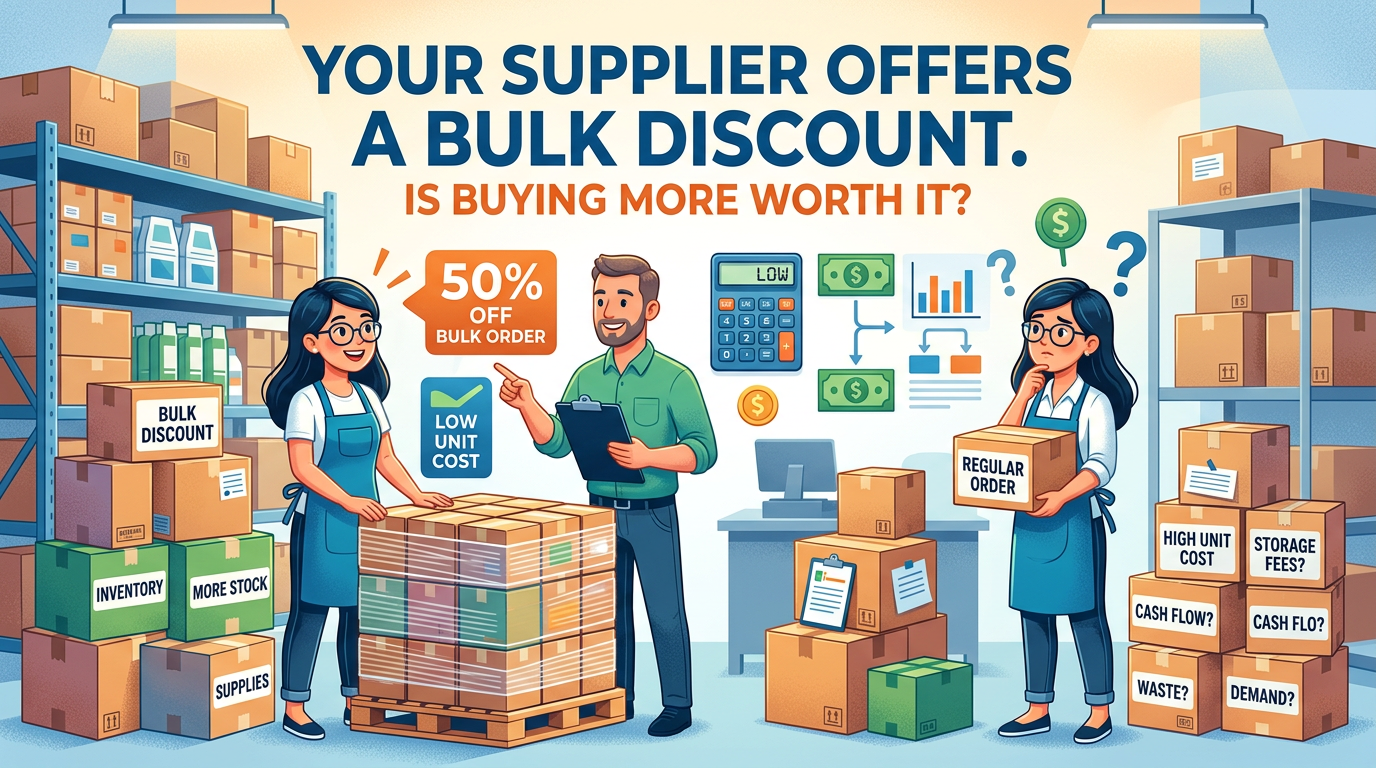
The offer arrives at an appealing moment. Your supplier is offering a lower price if you increase your next order, and the saving looks substantial. The products are familiar, the relationship is established, and buying now appears to protect your margin on future sales.
For a business owner, it can feel difficult to turn down. If you expect to need the goods eventually, why pay more for them later?
The challenge is that a lower unit price tells only part of the story. A larger order also changes how much cash leaves the business, how long goods remain in storage, and how much demand you need before that money returns. What looks like an immediate saving can become a longer financial commitment than expected.
Bulk purchasing can be worthwhile, but the decision needs to reflect the way your business sells, stores, and pays for stock. Before accepting the offer, it helps to examine what the discount actually saves and what you must commit to receive it.
Start With the Quantity You Actually Need
A supplier’s minimum order requirement should not become your demand forecast. Before considering the offer, establish how much stock the business would normally purchase without the discount.
That baseline should reflect current stock, outstanding orders, confirmed customer requirements, and realistic expected sales. It should also account for goods that are damaged, reserved for particular customers, or otherwise unavailable for ordinary sale.
Suppose your usual order is 500 units, but the discount requires you to purchase 1,500. The important change is not simply a cheaper price. You are bringing forward the purchase of another 1,000 units.
Those additional units need a commercial purpose. If they represent demand that is reasonably predictable, the proposal may deserve further consideration. If they depend on an optimistic sales target, the uncertainty should be visible before anyone approves the order.
Separate the Saving From the Additional Cash Commitment
Consider a simplified example. Your supplier normally charges S$20 per unit, so your regular order of 500 units costs S$10,000. It offers a 10 per cent discount if you buy 1,500 units, reducing the price to S$18 each.
The larger order costs S$27,000. Compared with buying the same 1,500 units at S$20, the apparent purchase saving is S$3,000. However, compared with your usual immediate order, you must pay another S$17,000 now.
Both figures matter. The S$3,000 represents a potential saving against purchasing the same quantity at the undiscounted price. The S$17,000 represents the extra immediate cash commitment, assuming payment is due at the same time.
The saving only provides a useful comparison if you would otherwise need those goods and could buy them at the assumed price. It does not account for additional storage, financing, damage, or markdowns. Keeping these distinctions clear prevents a discount percentage from dominating the decision.
Work Out How Long the Stock Will Last
The time needed to sell or use the order is central to the assessment. A large quantity of a fast-moving product may be manageable, while the same expenditure on slow-moving items could tie up cash for much longer.
If your business sells 250 units a month, an order of 1,500 units represents approximately six months of sales before considering existing stock. If you already hold another 500 units, the combined quantity represents approximately eight months at that sales rate.
This is only a starting estimate. Sales may vary by season, customer, or promotion, so management should examine the pattern behind the average.
The question is whether the expected holding period fits the product and the business. An item needed consistently throughout the year presents a different decision from one whose popularity depends on a short season or a changing customer preference.
Test the Demand Behind the Order
Past sales provide evidence, but they do not guarantee future demand. A product may have sold strongly because of a temporary promotion, a one-off customer order, or a competitor’s supply problem.
Before buying substantially more, identify how much demand comes from repeat business and how much depends on uncertain developments. Customer enquiries and expressions of interest should not automatically be treated as confirmed purchases.
For example, a distributor may expect a customer to renew a large supply contract. If that renewal accounts for most of the proposed bulk order, the purchasing decision depends heavily on an event that has not yet occurred.
Management should make that dependency explicit. It may decide to wait for confirmation, reduce the quantity, or negotiate a different arrangement with the supplier. The important point is to avoid presenting uncertain demand as if it were already secured.
Look at When the Cash Will Return
Selling stock and collecting payment are separate events for businesses that offer customer credit. Goods may leave the warehouse long before the related cash reaches the bank.
A bulk purchase can therefore create a longer funding period than the expected selling time suggests. The business pays the supplier, holds the stock, delivers it, and then waits for the customer’s payment.
Management should examine these dates together. If supplier payment is due before most of the goods are sold, the difference must be funded from available cash or another source.
The review should include payroll, rent, existing supplier commitments, and other payments falling due during that period. A purchase can offer a reasonable margin while still leaving the business short of flexibility at an inconvenient time.
Calculate the Extra Cost of Holding More
Additional stock can create costs that are easy to overlook because they do not appear on the supplier’s quotation. Storage, handling, insurance, and financing may change when the order becomes larger.
Focus on the costs that differ between the options. If the goods fit safely into existing unused space without additional expenditure, assigning the entire warehouse rent to the offer would distort the comparison. If the order requires rented overflow space, that additional expense belongs in the decision.
Handling also deserves attention. Extra movements between locations, repeated sorting, and more complicated picking can consume staff time even when no new employee is hired.
The objective is a realistic estimate of what changes because of the larger order. That estimate should be compared with the expected purchase saving, with uncertain amounts clearly identified.
Consider the Risk of Stock Losing Value
Some goods become less attractive or less usable as time passes. Food products have shelf-life constraints, technology can become outdated, and packaging may cease to fit a customer’s requirements.
Even durable products can lose commercial value. A customer may change its specifications, a new model may replace an existing line, or demand may shift towards a different size or colour.
A discount provides limited protection if the business later needs to sell excess stock at a substantial markdown. In the earlier example, a S$3,000 purchase saving could be reduced or eliminated by losses on goods that remain unsold.
Management should consider plausible outcomes rather than assuming every unit will sell at the current price. Products with uncertain demand or limited resale options require particular care when committing to a larger quantity.
Check Whether Supply Security Adds Real Value
The financial case for buying more may include continuity of supply. Holding additional stock can be useful where a shortage would interrupt production or prevent the business from fulfilling confirmed orders.
That benefit should be assessed separately from the discount. How reliable is the supplier? How long would replacement stock take to arrive? Are alternative suppliers available, and would their products meet the required specifications?
A business using an essential component with a long replenishment time may reasonably value additional stock differently from a retailer buying readily available merchandise.
However, supply concerns should be supported by evidence. A general fear that prices might rise or goods might become unavailable is not enough to justify any quantity. The proposed order should remain connected to a considered operating need.
Ask Whether You Can Negotiate the Structure
The choice may not be limited to accepting the entire order immediately or rejecting the discount. A supplier may be willing to discuss staged deliveries, a smaller volume threshold, or pricing based on cumulative purchases over an agreed period.
For instance, a business could ask whether the quoted quantity can be delivered in several batches. This might reduce storage pressure, although the payment obligations and cancellation terms would still need careful attention.
Other useful questions concern product mix and returns. Could the order include several proven sellers rather than one item? Are exchanges possible if a particular variation sells more slowly?
Any agreed flexibility should be documented. Verbal reassurance that the supplier will “work something out” later is a weak basis for committing cash to stock the business may struggle to use.
Compare the Offer With Realistic Alternatives
An offer can appear especially attractive when compared only with the supplier’s standard price. Management should also consider realistic alternatives available to the business.
These might include smaller purchases at normal intervals, another approved supplier, or a different delivery schedule. The alternatives should be compared on equivalent specifications, quality, and service, rather than price alone.
Smaller orders may cost more per unit but allow the business to respond as demand changes. A larger order may reduce purchasing frequency and provide continuity, while requiring more cash and storage capacity.
Neither approach is automatically superior. The comparison should show which costs and risks the business accepts under each option, using a consistent period and credible assumptions.
Be Careful When Borrowing to Capture a Discount
If the bulk order requires borrowing, financing costs become part of the comparison. Interest, fees, and repayment timing can reduce the benefit of the lower purchase price.
The business should examine how long funding is likely to be needed. A forecast based on rapid sales and prompt collection may understate the cost if stock moves slowly or customers pay late.
It is also useful to consider whether the borrowing reduces capacity to fund another need. Using an available facility for inventory may leave less room for an equipment failure or another unexpected commitment.
Borrowing does not automatically make the order unsuitable. It does mean the discount should be evaluated alongside the full funding obligation, rather than as a saving that stands on its own.
Agree on Who Can Approve the Commitment
Purchasing decisions can become inconsistent when one employee focuses on securing a discount while another is responsible for managing cash. Both perspectives are useful, but they need to be considered together.
For a significant order, the person proposing the purchase should explain the quantity, demand assumptions, expected holding period, and payment terms. Finance can assess the cash implications, while operations can confirm storage and handling capacity.
Management should set an approval process appropriate to the size and risk of the commitment. A routine replenishment order may require less review than a purchase covering many months of expected sales.
The purpose is to make the decision clear. Everyone involved should understand why the larger order is justified and which assumptions need monitoring afterwards.
Review Whether the Discount Delivered Its Promise
The decision is not complete when the goods arrive. Reviewing the outcome helps the business understand whether its purchasing assumptions were sound.
Compare the actual selling period with the original estimate. Check whether additional storage or handling was needed, whether goods required markdowns, and whether the expected cash collection occurred.
If the order performed well, identify why. Perhaps demand was stable, the product had a long useful life, and the payment terms matched the sales cycle. Those characteristics may help assess future offers.
If the result was disappointing, examine the cause before repeating the purchase. A lower price cannot compensate indefinitely for ordering more than the business can sell or use.
Better Records Make Better Purchasing Decisions
Owners need reliable information to assess these offers. Stock quantities, sales histories, supplier balances, and customer collection patterns all contribute to the decision.
Where records are incomplete, a purchasing proposal may rely on impressions such as “this item always sells well” or “we will need it eventually”. Those statements become more useful when supported by recent figures and an explanation of unusual activity.
Gekonnt offers accounting and bookkeeping services that can support businesses in maintaining organised financial records. Owners considering their next purchasing commitment can discuss their record-keeping needs with the firm and clarify what information would help them understand their financial position.
The commercial decision remains with management. Reliable records provide a stronger foundation for judging affordability, timing, and the assumptions behind an expected saving.
Buy More When the Whole Decision Makes Sense
A bulk discount can create value when the goods are needed, demand is credible, and the business can comfortably support the resulting commitment. The benefit becomes clearer when additional costs and risks have been considered alongside the quoted saving.
Before agreeing, establish how much you would normally buy, how long the additional stock will last, and when the related cash is likely to return. Consider what happens if demand is weaker than expected and whether the supplier can offer a more suitable arrangement.
The best purchase is not necessarily the one with the lowest unit price. It is the one that meets the business’s needs at an acceptable overall cost while preserving enough flexibility to manage what comes next.
A supplier’s offer may be worth accepting. The reason should be that the numbers and operating conditions support it, with the discount forming one part of that judgement.